By Rob C.
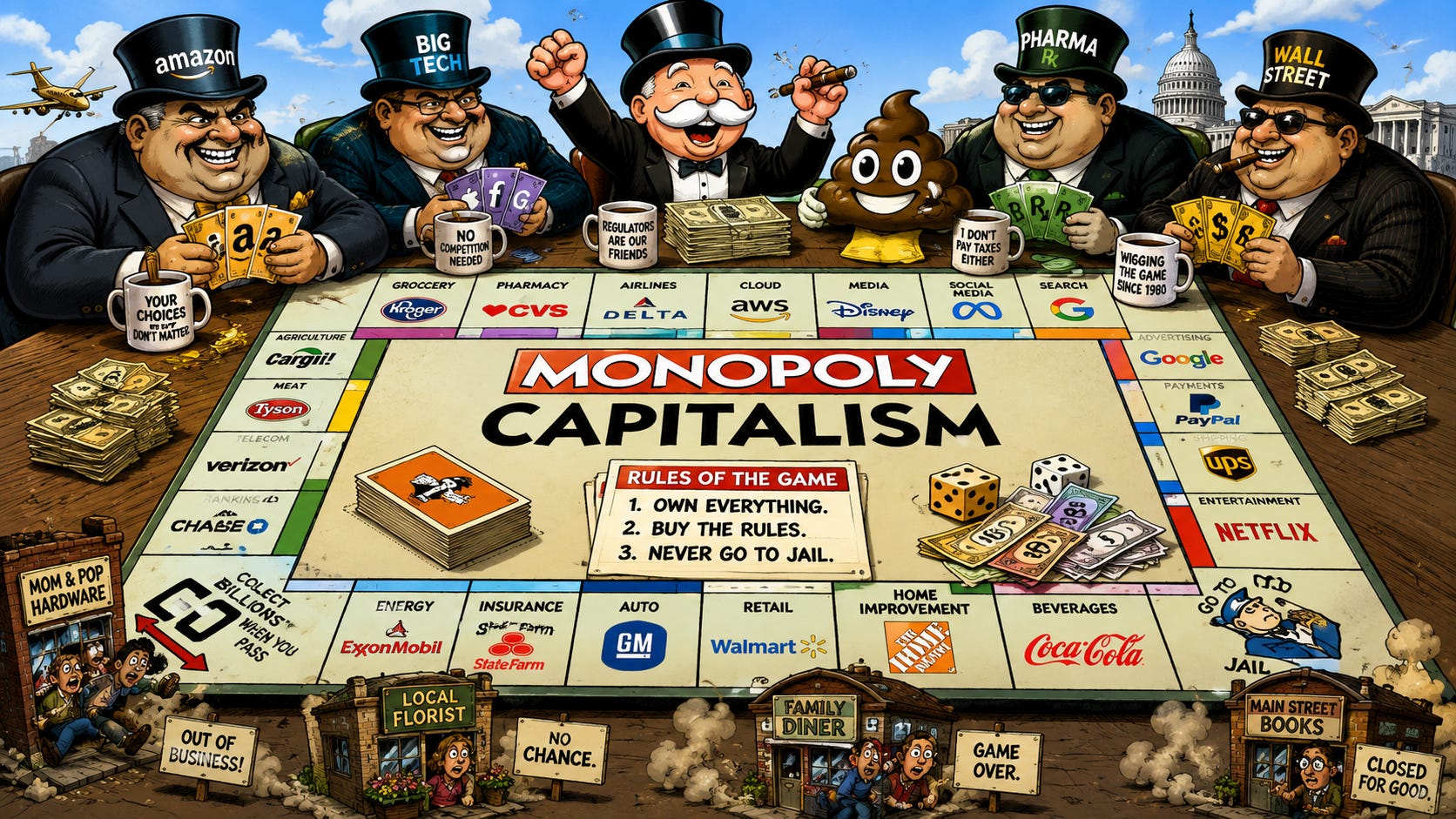
TL;DR: Monopoly power in America isn’t a natural occurrence—it’s a carefully engineered corporate take-over. Decades ago, judges and politicians abandoned early antitrust principles that protected democracy from mega-corporations, replacing them with a toothless “consumer welfare standard” that allowed massive companies to crush competition as long as prices stayed low. Today, companies trap users in degrading, low-quality ecosystems (”enshittification”), while the tax code and antitrust enforcement are rigged to reward political allies and punish rivals. When corporations become “too big to fail” and “too big to jail,” we lose the ability to self-govern entirely.
Good morning. Grab your coffee, pull up a chair, and let’s talk about how American capitalism stopped being about innovation and competition, and became a high-stakes protection racket for a handful of mega-corporations.
When Size Mattered
There was a time in this country when the law recognized a basic truth: concentrated economic power is a direct threat to democracy. Supreme Court Justice Louis Brandeis famously argued that “bigness” itself was dangerous—that allowing a single corporation to dominate a market destroys self-governance, regardless of whether that company promises low prices.
For most of the 20th century, that principle guided antitrust enforcement. Then came the late 1970s and the rise of the “Chicago School” of economics, led by figures like Robert Bork. Bork’s 1978 book, The Antitrust Paradox, argued that antitrust law had nothing to do with preventing corporate monopolies or protecting democracy. Instead, he claimed it had only one purpose: keeping consumer prices low.
By the early 1980s, the courts swallowed Bork’s argument hook, line, and stinker. The result was the “consumer welfare standard”—a legal loophole big enough to drive an Amazon delivery truck through. Under this rule, a company could crush every small business in sight, control supply chains, and corner an entire industry, and the courts would smile and wave it through as long as prices didn’t immediately shoot up.
This wasn’t just a Republican project, either. The “Watergate Babies”—the wave of reformist Democrats elected in the 1970s—abandoned the New Deal trust-busting tradition, embracing deregulation and corporate consolidation right alongside their conservative colleagues.
The Amazon Paradox and the Curse of Bigness
The disastrous real-world consequence of the consumer welfare standard is that it made sheer corporate size legally invisible to regulators.
As law scholar (and former FTC Chair) Lina Khan pointed out in her landmark 2017 paper “Amazon’s Antitrust Paradox,” modern tech giants don’t build monopolies by hiking prices right away. They do it by undercutting competitors at a loss for years, expanding simultaneously into cloud computing, logistics, advertising, and publishing, until they become essential infrastructure. Once a company becomes the road every other business must travel on, it can dictate terms to everyone.
Author Zephyr Teachout emphasized that this market capture isn’t just about Big Tech—it dominates agriculture, airlines, and pharmaceuticals. Meanwhile, Tim Wu, author of The Curse of Bigness, explicitly framed this extreme corporate concentration as a direct precursor to political authoritarianism. As Wu pointed out, the economic concentration of the Gilded Age paved the way for 20th-century fascism.
When Khan was appointed FTC Chair in 2021 and Wu joined the National Economic Council, it briefly looked like regulators might finally start swinging the trust-busting hammer again—culminating in the FTC’s historic 2023 antitrust lawsuit against Amazon for trapping and exploiting consumers.
Welcome to “Enshittification”
What happens to a platform or service once all genuine competition has been systematically executed? Tech commentator Cory Doctorow coined the perfect term for it: enshittification.
Doctorow outlines a predictable, three-stage decay for modern corporate monopolies:
The Honey-Moon Phase: The platform treats users amazingly well, offering below-cost services to build a captive audience and lock them in.
The Partner Squeeze: Once users are trapped, the platform shifts to abusing users in order to lure in business customers and advertisers.
The Final Extraction: Once both users and business customers have nowhere else to go, the platform turns around and abuses everyone simultaneously to maximize quarterly shareholder value.
This isn’t an accident, nor is it a case of bad management. It is the totally rational outcome of removing the four forces that used to keep corporate greed in check: fear of competition, aggressive regulatory enforcement, user choice, and organized labor.
Look at Amazon today: the company that once built customer loyalty with cheap goods and fast shipping now buries genuine search results beneath paid sponsored placements and sets prices at will—because by the time consumers noticed the quality decaying, there was nowhere else left to shop.
Pay-to-Play Antitrust: The New Enforcement Racket
Under the current administration, antitrust enforcement hasn’t just reverted to the old corporate-friendly ways—it’s been turned into a political weapon.
In August 2025, Donald Trump revoked Biden’s 2021 competition executive order, abandoning directives that instructed the FTC and DOJ to protect small businesses and workers from predatory mergers. In March 2025, he took the unprecedented step of firing the FTC’s two Democratic commissioners—a move currently tied up in a Supreme Court challenge over whether the president can unilaterally dismantle independent regulatory agencies.
While the Trump administration claims it is still tough on mergers, watchdogs like the American Economic Liberties Project point to a much darker reality. Antitrust enforcement is no longer about stopping market harm; it has become openly negotiable.
Under FTC Chairman Andrew Ferguson, regulators have signaled a willingness to greenlight massive corporate deals—provided those companies are friendly to the White House. Watchdogs tracking the “Trump Merger Boom” report a steady stream of mergers approved for politically connected firms. Just like with pardons and inaugural slush funds, antitrust enforcement has been converted into another pay-to-play racket: play ball with the administration, and your monopoly gets a free pass.
The Great Corporate Tax Ruse
While regulators gutted antitrust enforcement, lawmakers were busy gutting the corporate tax base.
The corporate tax rate was slashed repeatedly under Reagan in 1981 and 1986, and then brought down from 35% to 21% by Trump’s 2017 Tax Cuts and Jobs Act—the largest corporate tax cut in American history.
In 2025, the “One Big Beautiful Bill” didn’t even bother lowering the headline rate below 21%. Instead, it engineered complex loopholes underneath it:
Immediate Expensing: Restored full, immediate tax deductions for corporate investments in equipment, machinery, and facilities, letting mega-corporations wipe out their near-term tax liabilities entirely.
Offshoring Rewards: Reduced taxes on foreign corporate earnings and canceled penalties designed to stop companies from parking profits in overseas tax havens.
Permanent Pass-Throughs: Made the 20% pass-through tax deduction permanent, delivering a massive tax break to LLCs and partnerships owned by the ultra-wealthy.
The sticker price for corporate taxes stays fixed at 21% for the evening news, while the actual tax bills for Fortune 500 companies shrink down to near zero.
The Death of Self-Governance
For forty years, both political parties operated on a hollow, corporate-funded myth: that unrestrained corporate scale and unchecked corporate profits are inherently good for society, and that any government attempt to protect workers or small businesses is “unnecessary intervention.”
The result of this four-decade project is a country that stripped its own tax base while simultaneously dismantling the enforcement mechanisms meant to keep corporate predators in check.
We have created an economy where “too big to fail” is no longer a warning—it is standard operating procedure. When “too big to fail” inevitably becomes “too big to jail,” corporations stop serving the public marketplace and start owning the political one. And once mega-corporations control both our economy and our laws, self-governance is officially dead.
Join the Resistance – before it’s too late.
Like, Share, and Subscribe—before Amazon buys the rights to the First Amendment and puts my column behind a Prime subscription!
Follow my work:
Substack: democracy4sale.substack.com
Web: democracy4sale.com
Facebook: facebook.com/democracy4sale/
YouTube: youtube.com/democracy4sale/
Rob Cain is the author of “Democracy for Sale: How Corporate Greed Is Corrupting Democracy and Endangering the Planet,” and writes “Our Broken Systems” at democracy4sale.com.