By Rob C.
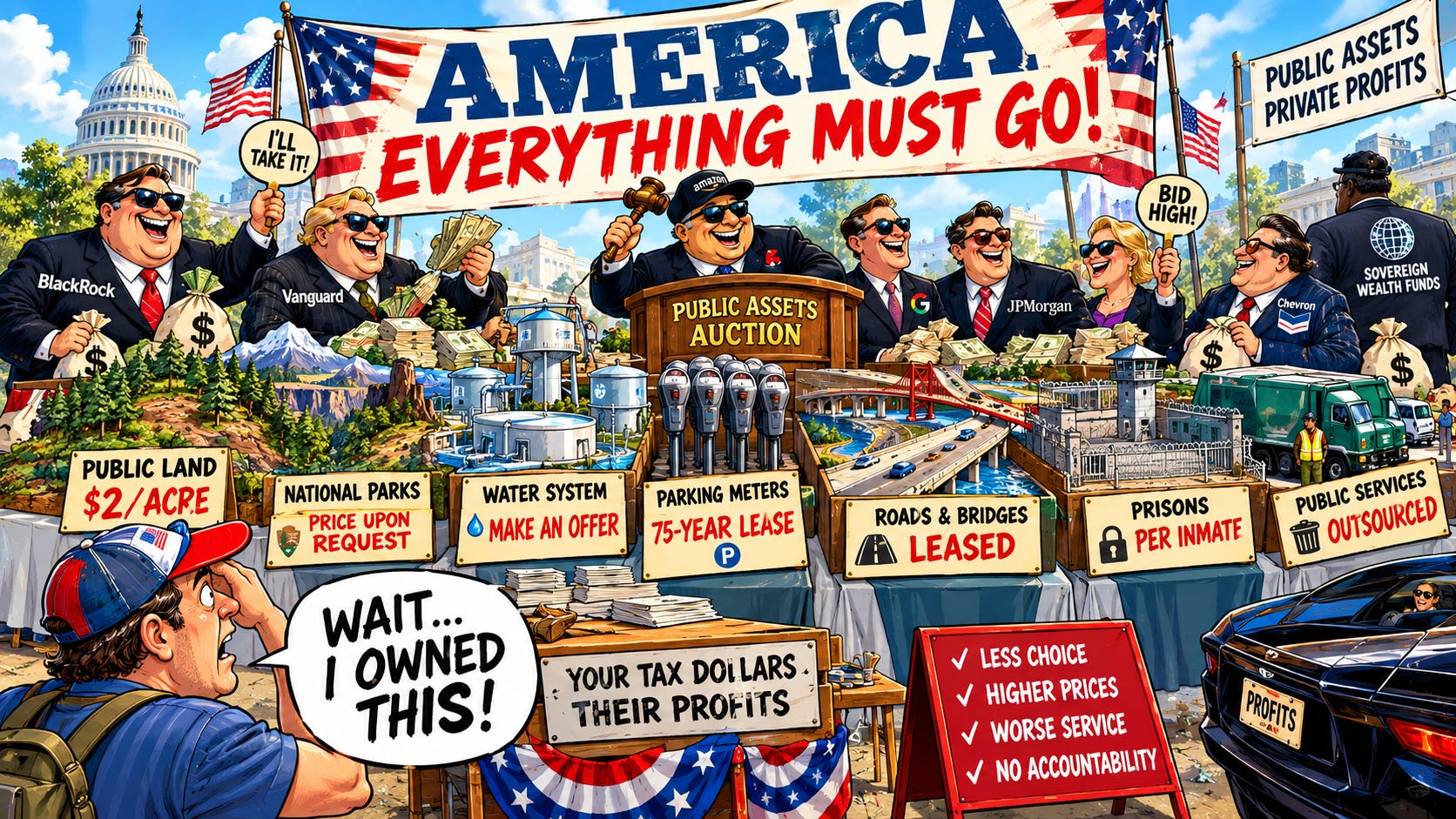
TL;DR: You may not realize it, but you are quite wealthy. You own a lot of stuff — no, not personally, but as a citizen of the United States, you hold a share in a vast collective inheritance. The government owns immense stretches of land and resources, and by extension, so do you. That road, that bridge, that park down the street — you own a piece of those too. The water system that fills your glass, the sewage line that carries waste away, the trash truck that comes every week: these are, in most cases, collectively owned, paid for and maintained through the taxes every citizen contributes. This is what’s known as “the commons” — things set aside for everyone to share, or built and sustained through collective public investment rather than private capital. But over the last fifty years, politicians have been quietly liquidating your collective inheritance and selling it off to Wall Street, private equity firms, and foreign sovereign wealth funds for pennies on the dollar. Today, we don’t just pay taxes; we pay rent to mega-corporations for the basic right to park a car, drink clean water, or exist in public space.
Good morning. Grab your coffee, pull up a chair, and let’s talk about how the ruling class decided to take the entire concept of “the public good” and turn it into a private fire sale.
Here’s a fun fact: as a citizen of the United States, you hold a legal share in a vast, staggering collective inheritance. You co-own the vast stretches of public land, the national parks, the rivers, the bridges, the sewage lines, and the water treatment plants that keep civilization from collapsing into chaos. This is called “the commons”—the shared assets built, paid for, and maintained through generations of taxpayer dollars.
Or at least, it was your inheritance. Over the past half-century—and at breakneck speed over the last decade—politicians from both parties have been quietly selling, leasing, and transferring these public assets into private hands. They called it “fiscal responsibility” and “modernization”. In reality, it was the greatest asset-stripping scheme in human history.
Our Wall Street Government
If you think privatization is just about contracting out a few janitorial services, the sheer scale of the private takeover will make your head spin.
There are now 2.6 times as many federal contractors as actual federal employees. Out of America’s combined $6 trillion in federal, state, and local government spending, roughly $1 trillion flows straight into the pockets of private corporations rather than public agencies.
This was never about “shrinking government,” despite what right-wing think tanks promised. It simply created a massive, shadow “private government”—one that spends your tax dollars with zero of the transparency, public oversight, or legal accountability required of actual government agencies. As Donald Cohen and Allen Mikaelian document in The Privatization of Everything, this was a thoroughly bipartisan betrayal. In fact, Bill Clinton did more to accelerate the privatization machine than almost any other president.
And does it save money? Absolutely not. As economist Elliott Sclar points out in You Don’t Always Get What You Pay For, the corporate myth that market competition forces private companies to deliver better service at lower costs collapses instantly in the real world. Why? Because privatized public services almost always operate as regional monopolies. You can’t choose a competing sewer line or trash hauler when your city signs a 30-year deal. The “free market” vanishes, leaving you trapped with a single private monopoly whose only goal is squeezing shareholders a profit.
As political philosopher Chiara Cordelli warns in The Privatized State, when you hand state functions—like prisons, welfare offices, or water utilities—to private corporations, you aren’t modernizing government. You are regressing back to a feudal “state of nature” where corporations exercise unaccountable power over citizens who never voted for them.
The Damage Done: The Great Chicago Parking Heist
If you want to see how insane this gets, look no further than Chicago’s 2008 parking meter deal—the undisputed crown jewel of municipal stupidity.
Desperate to plug a budget shortfall during the Great Recession, Mayor Richard M. Daley rammed a deal through the City Council with a laughable 72 hours of review. Chicago leased all 36,000 of its public parking meters for 75 years to a consortium led by Morgan Stanley and backed by the Abu Dhabi Investment Authority for a single upfront check of $1.15 billion.
The city’s own inspector general later concluded that Chicago sold the meters for at least $1 billion less than they were worth.
The result? Parking rates skyrocketed from $3.00 an hour in 2008 to $7.00 an hour today. But here’s the kick in the teeth: the contract includes “true-up” provisions. If Chicago closes a street for a block party, a construction project, or a public safety emergency, the city must pay the private company for “lost revenue”.
In May 2025 alone, Chicago’s City Council had to approve a staggering $32 million payout to the meter company just to compensate them for spaces taken out of service during COVID-19 shutdowns! By the time the lease ends in 2083, those private investors will have extracted an estimated $12 billion from Chicago drivers on a $1.15 billion investment. When Chicago’s current mayor looked into buying the meters back, the cost had ballooned to triple the original sale price. The city literally priced itself out of ever owning its own streets again.
Turning On the Tap: Pennsylvania’s Water Racket
If you think losing parking meters is bad, try losing control of your drinking water.
In 2016, Pennsylvania passed Act 12, a gift-wrapped piece of legislation that changed how municipal water systems are valued when sold to for-profit corporations. Instead of valuing physical pipes and plants, private buyers were allowed to factor in speculative “market value” and bake future infrastructure spending directly into mandated rate hikes.
Since the law passed, private companies have swallowed up at least 21 local water and sewer systems across Pennsylvania. The state’s Public Utility Commission chairman admitted that these private corporate takeovers resulted in rate hikes between 44.9% and 116.6%.
· In Scranton, residents were slapped with a proposed 24.2% rate hike right after Pennsylvania American Water bought their system.
· In New Garden Township, sewer bills skyrocketed by nearly 85% after a private takeover.
· In Bucks County, residents barely managed to defeat a $1.1 billion sewer sale to Aqua Pennsylvania—and only because 150 angry citizens physically showed up to public hearings to stop it.
When a private corporation buys your water system, they aren’t improving your pipes out of civic duty; they are turning your daily shower into a high-margin dividend for remote investors.
Selling America by the Acre
It isn’t just municipal infrastructure being auctioned off; it’s the physical land itself.
Since returning to office, the Trump administration has put nearly 24.5 million acres of public land up for oil and gas leasing—an area larger than the entire state of Indiana—with huge swaths auctioned off for as little as $2 an acre. Over 81% of all Bureau of Land Management land in the West (more than 200 million acres) is now open for fossil fuel exploitation.
And what’s the rush? Nearly half of the land already leased isn’t even producing energy; it’s being held by speculators who lock up public land for future corporate profit while sitting on it idle.
The administration has moved to:
· Reopen the coastal plain of the Arctic National Wildlife Refuge.
· Strip protections from 13 million acres of Alaskan wilderness.
· Eliminate roadless protections for nearly 40 million acres of national forest.
· Open more than 1 million acres of Southern California to fracking.
Mining and drilling projects now encroach on Sequoia National Park, Big Cypress National Preserve, and Chaco Culture National Historical Park—a sacred site set aside by Theodore Roosevelt in 1907. Meanwhile, the administration proposed cutting nearly $1 billion from the National Park Service budget, threatening to force hundreds of public parks to close even though 69% of Americans violently oppose the cuts.
Sure, the government still holds the paper deed to the land. But when a private corporation holds exclusive rights to drill, mine, and pollute that land for decades—leaving taxpayers to foot the cleanup bill when they walk away—the distinction between “public land” and “private property” completely vanishes.
Prisons: A Legalized Human Trafficking Racket
Nothing highlights the grotesque illegitimacy of privatization better than the private prison industry.
In 2016, Obama moved to phase out federal private prison contracts. In 2017, Trump reversed it. In 2021, Biden banned them again, closing the last federal private prison contract by 2022. Then, on his very first day back in office in January 2025, Trump rescinded the ban yet again.
Four presidents, four complete reversals in less than a decade. The basic legal authority to lock up a human being is being treated like a partisan toggle switch, flipped back and forth depending on who holds power.
This $80 billion private prison industry has now pivoted aggressively toward immigration detention, where masked federal contractors operate with near-zero public transparency and complete immunity. When basic human rights are tied to a corporate earnings report, cruelty isn’t a bug—it’s the business model.
All Sales Are Final (Unless We Stop Them)
What connects a $7 parking meter in Chicago, an 85% water bill hike in Pennsylvania, an oil rig outside a national park, and a private prison contract?
It’s not bad luck, and it’s not accidental incompetence. It is a deliberate, quiet, 50-year project to repackage the American commons and hand it to Wall Street, private equity firms, and foreign sovereign wealth funds.
Every single sale is sold to us as “fiscally responsible.” Every contract is framed as “increasing efficiency.” But efficiency for whom? Certainly not for the family in Scranton whose utility bills are eating their paycheck. Certainly not for the Chicago driver paying rent on public streets to Abu Dhabi investors until the year 2083.
This is a quiet, slow-motion corporate coup. It doesn’t use tanks or soldiers; it uses financial consultants, lobbyist checks, and 72-hour City Council votes.
If we don’t reclaim what belongs to us while the deeds still nominally say “public,” we will wake up in a country where we pay a subscription fee to a mega-corporation just for the right to drink clean water and breathe the air.
Join the Resistance!
Like, Share, and Subscribe— before Wall Street buys the rights to the air you’re breathing while reading this!
Follow my work:
Substack: democracy4sale.substack.com
Web: democracy4sale.com
Facebook: facebook.com/democracy4sale/
YouTube: youtube.com/democracy4sale/
Rob Cain is the author of “Democracy for Sale: How Corporate Greed Is Corrupting Democracy and Endangering the Planet,” and writes “Our Broken Systems” at democracy4sale.com.