By Rob C.
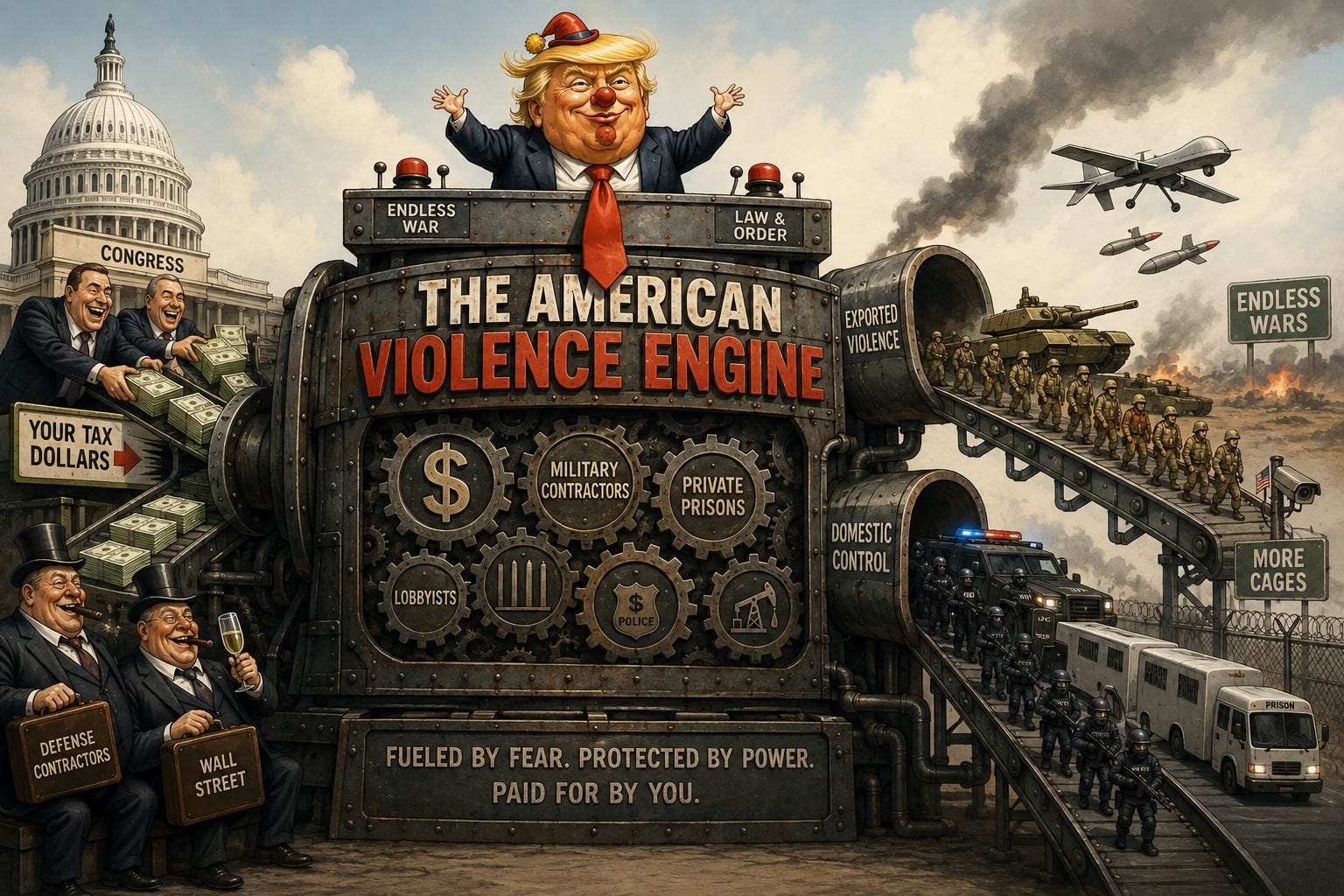
TL;DR: We like to tell ourselves a nice little story about American violence: it happens overseas, or in cities, it’s a policing problem, and it’s different than the “white collar” crime that happens in corporate boardrooms. Every piece of that story is wrong. Mass military spending and domestic mass incarceration are two sides of the same coin, draining resources from public welfare to fuel a bipartisan violence engine. From militarized rural policing to corporate immunity and campus crackdowns, our systems protect capital and punish the working class—and simply “getting back to normal” won’t fix it.
Good morning. If you step back and look at our massive, trillions-deep U.S. military budget next to our monstrous domestic mass incarceration system, you’ll notice they drink from the exact same well.
They share the same underlying institutional logic, the same endless appetite for taxpayer capital, and the same quiet, bipartisan rubber stamp every fiscal year. Money that could go toward healthcare, public infrastructure, and actual social welfare instead funds an empire of control—both overseas and right outside your front door.
And don’t look surprised when that violence comes home. Police militarization traces directly back to veterans returning from foreign conflicts, bringing military gear, battlefield tactics, and an operational mindset straight into domestic police departments.
At the same time, we have to push back hard on the smug “coastal disdain” far too often aimed at rural America. Rural communities have disproportionately supplied the boots on the ground for this empire’s endless wars. And when those soldiers return, those same rural towns disproportionately absorb the resulting PTSD, mental health crises, and rampant opioid addiction, all while watching their local public services get stripped to the bone.
Rural Incarceration and Police Violence—By the Numbers
The corporate media seems to gloss over one of the most underreported domestic stories in America. They love painting police violence strictly as a big-city story, but the actual data tells a very different tale:
Your chances of being locked up are now statistically higher in rural and suburban areas than in urban centers.
Roughly three-quarters of police killing fatalities in 2020 occurred in rural and suburban areas—a reality hidden because media attention and academic research overwhelmingly fixate on major metropolitan centers.
Indigenous people are statistically the most likely group to be killed by police. Because these deaths frequently happen in remote areas with no crowds, no news crews, and no smartphone footage, they trigger virtually zero public outcry.
More white people are killed by police each year than any other racial group in raw numbers. Eight of the ten states with the highest rates of fatal police shootings are in the West, where Black residents average barely 3% of the population.
White residents make up the majority of rural populations in almost every state and represent roughly two-thirds of the people killed by police in rural communities.
To be clear on context: white Americans are still killed by police at a much lower rate than Black Americans nationally on a per-capita basis. But compared to white people in the UK or Germany, white Americans face a dramatically elevated risk of being killed by law enforcement—simply because overall U.S. police violence rates are so ridiculously high across the board.
The Shocking Training Gap
If you want to understand why our domestic enforcement feels so trigger-happy, look at how little we require of officers before handing them a gun and a badge:
The average U.S. police academy runs for just 11 weeks. Compare that to European nations requiring up to three full years, or Scandinavian countries where police academy admission is as fiercely competitive as elite university entry.
The average police department size in the U.S. is just 10 to 12 officers, making standardized quality control and high-level training nearly impossible to implement nationally.
The punchline? In several U.S. states, it legally requires more mandatory training hours to get a license as a manicurist or cosmetologist than it does to become an armed police officer with authority to use lethal force.
The Fetish of Secrecy
The system is structurally designed to protect itself from accountability:
There is no comprehensive national database tracking police use of force. The 1994 Crime Bill nominally mandated this data collection, but Congress attached zero funding penalties for noncompliance—so departments simply ignore it.
Qualified immunity acts as an almost impenetrable legal shield, blocking civil rights lawsuits against individual officers before they ever reach a jury.
Taxpayers pay the bill, not the cops. Even when a lawsuit succeeds, the department or municipality pays the massive settlement—the officer rarely loses a dime.
Police unions have carved out absurd privileges. In many jurisdictions, officers get to review body-camera footage before giving an official statement about a shooting, allowing them to tailor their testimony directly to what the camera caught.
Sexual misconduct is the second most frequently reported form of police abuse after excessive force. It disproportionately targets low-income individuals, LGBTQ people, and Black women. Roadside body-cavity searches on paper-thin pretexts continue routinely, and strip-searches of students—from preschool to high school—persist despite constitutional violations because courts stubbornly refuse to impose real penalties on officials.
Corporate Crime vs. Street Crime: A Two-Tiered Joke
Mass incarceration and total corporate impunity are twin developments that grew up together. Both accelerated dramatically during the Clinton administration, which toughened street-crime enforcement for working people while simultaneously gutting corporate regulatory oversight. Clinton effectively formalized our two-tiered justice system, routinely staffing senior Department of Justice and SEC positions with insiders pulled directly from Wall St. financial conglomerates.
Consider the primary mechanism for handling massive corporate fraud: Deferred Prosecution Agreements (DPAs). Originally created as a second-chance tool for juvenile offenders to avoid a record, DPAs were hijacked late in the Clinton era—and turbocharged under Bush and Obama—to deal with corporate crime.
When a mega-corporation commits massive fraud, they don’t go to trial. They enter a DPA, pay a fine, and promise to be good. When they inevitably break the agreement, the government doesn’t prosecute individual executives; they just hand the company another DPA and issue a slap-on-the-wrist penalty.
These fines routinely don’t even equal a single quarter’s corporate profits, are often tax-deductible, and regulatory agencies frequently don’t even bother to verify whether the fines were paid.
Donald Trump is a Symptom, Not the Disease
It is easy for political commentators to blame our current mess entirely on Donald Trump, but Trump tapped into a real, deep-seated, bipartisan-generated sense of betrayal—he didn’t manufacture it out of thin air.
Remember, millions of voters who cast ballots for Trump had previously voted for Barack Obama twice. In 2008, Obama won deep-red Indiana. A significant chunk of 2016 Bernie Sanders primary voters ultimately shifted to Trump in the general election because they recognized that the system was fundamentally rigged against them.
The Democratic establishment’s sidelining of Bernie Sanders was one of its greatest self-inflicted political blunders. Sanders offered genuine, working-class populism, whereas Trump offered fake populism wrapped in a scam.
And if you think authoritarian suppression is unique to one party, look at our university campuses. The University of Pennsylvania recently brought in armed tactical police—complete with search warrants and drawn weapons—to raid a student residence over red paint splattered on a Benjamin Franklin statue, while introducing draconian speech restrictions. This trend of militarized campus crackdowns on free speech didn’t start yesterday; it expanded heavily under the Obama administration as well.
The idea held by Democratic elites that we can fix this crisis by simply “getting back to normal”—returning to Obama/Biden-era governance—misdiagnoses the entire problem. It was precisely the deregulation, non-prosecution of corporate criminals, and expansion of the security state during those “normal” eras that built the exact conditions exploited today. You cannot cure a disease by returning to the exact environment that incubated it. An empire of violence, at home and abroad, doesn’t get dismantled by nostalgia for the version of it that came before the current one.
F*CK ICE. RELEASE ALL THE FILES!
Please like, share, and subscribe — before campus security requests a SWAT team to audit my subscriber list!
Follow my work: Substack: democracy4sale.substack.com / Web: democracy4sale.com
Robert Cain is the author of “Democracy for Sale: How Corporate Greed Is Corrupting Democracy and Endangering the Planet.” Available at Amazon, Barnes & Noble, and independent booksellers everywhere.