By Rob C.
TL;DR: The 2026 midterms just cleared nearly $12 billion—officially the most expensive election cycle in American history. One man, Elon Musk, dumped $446 million into the pot all by himself. Trump’s super PAC is lounging on a $400 million cushion built almost entirely on seven-figure checks from billionaires. AIPAC moved over $100 million and handed every corporate lobby in town a step-by-step manual on how to buy a congressional primary. Crypto, AI, and online gambling giants rolled out their own super PACs, while $1.5 billion slithered in through dark-money groups that refuse to tell you who they are. Then, once the confetti settles and the votes are counted, corporations drop another $5 billion a year lobbying the exact people they just helped install. Let’s stop pretending this is a democracy with a money problem. It’s a high-end auction with a voting problem.
Welcome back to the wholly owned corporate-subsidiary named the United States.
Anyone with two functioning eyes can see that the Trump administration operates like a clearance sale on federal power, yet they are far from the only ones standing under the cash waterfall. Sure, Trump is hawking everything from meme coins to branded Bibles, and if your check clears, you can even pick up a presidential pardon on your way out the door. Just ask Binance founder Changpeng Zhao, who pleaded guilty to money-laundering, watched his company help the Trump family’s crypto venture rake in billions, and walked away with a shiny full pardon (Wall Street Journal). I’ve already cataloged plenty of the Trump crime family’s greatest hits, but Washington is packed to the rafters with politicians from both sides of the aisle who answer directly to the people signing their checks.
So let’s follow the money: the avalanche of cash poured into buying our elections, and the tidal wave poured into buying our government through lobbying once the ballots are tallied. It’s a very swampy swamp.
The $12 Billion Election Sale
Start with the sticker price. The 2026 midterms cost an estimated $11.9 billion at the federal level—shattering every midterm spending record in U.S. history (OpenSecrets). Four years ago, the tab was $8.9 billion. Ten years ago, total federal election spending sat around $4 billion. That is a complete tripling in a single decade, all while Congress tells working families with a straight face that there simply isn’t enough money in the budget for public schools or healthcare.
More than half of that tsunami—roughly $5.5 billion—flowed through PACs and super PACs, those magical legal loopholes allowed to raise unlimited cash as long as they pinky-swear not to coordinate with the candidates they’re boosting (OpenSecrets). Outside spending nearly doubled from 2022. Meanwhile, at least $1.5 billion arrived as “dark money” via nonprofits that never have to disclose a single donor, obliterating the previous record. Even The New York Times admitted its own $1 billion tally was a conservative low-end estimate.
Both parties are elbow-deep in the trough. Party leaders’ own dark-money affiliates funneled $197 million into their aligned super PACs this cycle—including $70.7 million from One Nation, the nonprofit tied directly to Senate Republican leadership (Sludge). Republican-aligned outside groups outspent Democratic ones by nearly $400 million, while Democratic candidates outspent Republicans out of their official campaign accounts. Different plumbing, exact same swamp.
The Billionaire Buyers’ Club
The undisputed heavyweight champion of buying political influence was the richest man on Earth. Elon Musk pumped $446 million into Republican groups this cycle (FEC data via Al Jazeera), smashing his own all-time donor record set when he spent $290 million in 2024 (Brennan Center). He dumped more than $150 million into the Texas Senate race alone trying to drag Ken Paxton across the finish line. Paxton lost to James Talarico anyway. Turns out you can buy wall-to-wall television ads, but you can’t always buy Texas.
The rest of the donor leaderboard reads like the VIP manifest for a mega-yacht party:
Richard and Elizabeth Uihlein: The shipping magnates tossed in $150 million for Republicans.
Jeff Yass and his wife: The trading billionaire family dropped $110 million for Republicans.
Marc Andreessen and Ben Horowitz: The Silicon Valley venture capitalists put up $92.2 million.
Miriam Adelson & the Winklevoss Twins: Adelson chipped in $67.6 million, while the crypto twins added roughly $55 million.
George Soros & Michael Bloomberg: Over on the Democratic side, Soros put in $102 million and Bloomberg added $84.2 million (Washington Post; Visual Capitalist).
Republican-aligned megadonors hold roughly a two-to-one cash advantage, but nobody in this billionaire boys’ club is writing checks out of the goodness of their hearts. They aren’t donating—they’re investing.
The President’s Piggy Bank
Then there is MAGA Inc., the super PAC bankrolling a president who is constitutionally barred from ever running again. By August, it was sitting on a $404 million war chest—more cash than any other federal fundraising committee—built on massive checks from billionaires like Adelson, Yass, and Andreessen (Bloomberg Government).
Pause and ask yourself why rational billionaires would shovel hundreds of millions of dollars to a politician whose name will never appear on another ballot. The Brennan Center spelled out the answer: 96% of MAGA Inc.’s money came from donors writing checks for $1 million or more—many of whom stand to profit directly from Trump’s policies, and several of whom have already pocketed personal favors from the Oval Office.
That isn’t a campaign fund. That is a luxury tip jar sitting right on top of the Resolute Desk.
AIPAC Wrote the Playbook
If you want a masterclass in how organized money bends Congress to its will, study AIPAC. Here is the beauty of the operation: AIPAC barely bothers with traditional lobbying, spending a modest $1.7 million on lobbying in the first half of 2026 (JNS). Its real muscle is raw campaign cash.
AIPAC’s PAC funneled $45.9 million to candidates and members of Congress this cycle, largely bundled from individual donors who route their checks through AIPAC so the organization gets full credit with the politician (Sludge). Throw in its super PAC, the United Democracy Project, and the combined operation cleared more than $104 million by August.
And they happily buy loyalty on both sides of the aisle:
Early in the cycle, AIPAC’s top recipient was Republican House Speaker Mike Johnson, pulling in $625,000 (Sludge).
House Democratic Leader Hakeem Jeffries collected $314,810 from pro-Israel sources, making it his third-largest industry backer (OpenSecrets via Newsweek).
In the Senate, Republicans Tom Cotton and John Cornyn sat right near the top of the payout list.
Of course, the stick matters just as much as the carrot. After helping oust Reps. Jamaal Bowman and Cori Bush in 2024, AIPAC’s super PAC dumped roughly $31 million into Michigan’s Senate primary to crush Abdul El-Sayed—the largest sum it has ever spent in a single race (Inside Political Money). It flopped; El-Sayed is now a senator-elect. To disguise its fingerprints, the group quietly routed another $13.1 million through shell committees with generic names that had zero mention of Israel (The Intercept). Meanwhile, on the right, the Republican Jewish Coalition spent $3.8 million to take out GOP Rep. Thomas Massie in his primary (JNS)—his unforgivable sin being a vote against unconditional foreign aid.
Facing mounting public backlash, AIPAC announced in October that it would stop endorsing candidates and making direct PAC contributions (CNBC). Hold your applause. They are keeping their super PAC wide open, which can still raise and spend unlimited dark money. The cash isn’t leaving Washington; it’s just moving into darker alleys where voters can’t track it.
Everyone Copied the Playbook
Every major industry looking to dodge federal regulators has now photocopied AIPAC’s blueprint. Corporations poured a record $737 million into super PACs this cycle—60% more than in the 2024 presidential election and more than 40% of all corporate election spending since the Supreme Court’s disastrous Citizens United ruling in 2010 (Public Citizen). Crypto, online gambling, and Big Tech/AI accounted for more than half of that corporate tidal wave.
Crypto led the charge. Its flagship super PAC, Fairshake—bankrolled by Coinbase, Ripple, and Andreessen Horowitz—spent roughly $154 million (Fast Company), building on the cash blitz that helped knock out Sen. Sherrod Brown in 2024. The AI sector immediately followed suit with Leading the Future, fueled by $50 million from Andreessen Horowitz alone, blowing over $8 million just to attack New York Democrat Alex Bores for the crime of co-writing a state AI safety bill (The Next Web). Meanwhile, rival AI money flowed into groups pushing for regulatory frameworks, including at least $40 million from Anthropic via a dark-money nonprofit (Reuters). Either way, the tech titans building the algorithms are paying to hand-pick their own referees.
The savviest operators don’t even bother picking sides. Both Fairshake and Leading the Future dumped money into the exact same politicians—like Rep. Ritchie Torres, who pocketed $2.5 million between the two (Fast Company). When you own both teams on the field, you never lose the game.
After the Votes: The Lobbying Machine
Buying the election is merely the down payment. Once the winners are sworn in, the real work begins. Federal lobbying hit roughly $5.3 billion in 2025—the largest annual haul in history and the biggest single-year spike since quarterly tracking started in 2008 (Bloomberg Government). That works out to roughly $10 million spent on influence per member of Congress, every single year.
The top spenders are the usual corporate suspects:
U.S. Chamber of Commerce: Big Business’s all-purpose wrecking ball spent $72.1 million in 2025.
National Association of Realtors: Dropped $54.4 million (OpenSecrets).
PhRMA: The pharmaceutical lobby blew a record $38.2 million, largely fighting proposals to tie American prescription prices to what other developed nations pay—a common-sense reform PhRMA hilariously smears as importing prices from “socialist countries” (OpenSecrets).
Tech & Auto Giants: Hospital networks, insurers, Meta ($26 million), General Motors ($19.7 million), and Amazon ($18.9 million) rounded out the top tier.
What are they buying with all that cash? Look at the top-lobbied issues of 2025: the federal budget, taxes, healthcare, defense, and trade (OpenSecrets). Budget and appropriations alone swarmed with roughly 5,700 registered lobbyists. Translated into plain English: they are paying to decide who gets your tax dollars, which billionaires pay zero taxes, who gets to keep gouging Americans for life-saving insulin, and which corporations score special tariff exemptions.
And under this administration, the single most lucrative commodity on K Street is personal proximity to the Oval Office. In 2025, a Trump-linked lobbying firm vaulted straight to the #1 spot in Washington, knocking longtime powerhouse Brownstein Hyatt down to second place (Bloomberg Government). Ballard Partners, founded by longtime Trump fundraiser Brian Ballard, claimed the crown by mid-year. Political access isn’t an unfortunate side effect anymore—it is the entire business model.
Who Owns Washington?
Step back and look at the whole board: billionaires and corporations hand-pick the candidates via super PACs; dark-money nonprofits launder the donor lists; AIPAC and its corporate copycats publicly execute anyone who steps out of line; and once the winners take their oaths, a $5 billion annual lobbying machine ensures they never forget who owns their lease. Donald Trump may be the most shameless carnival barker in this marketplace, but he didn’t invent the system—and it won’t magically evaporate the day he leaves office.
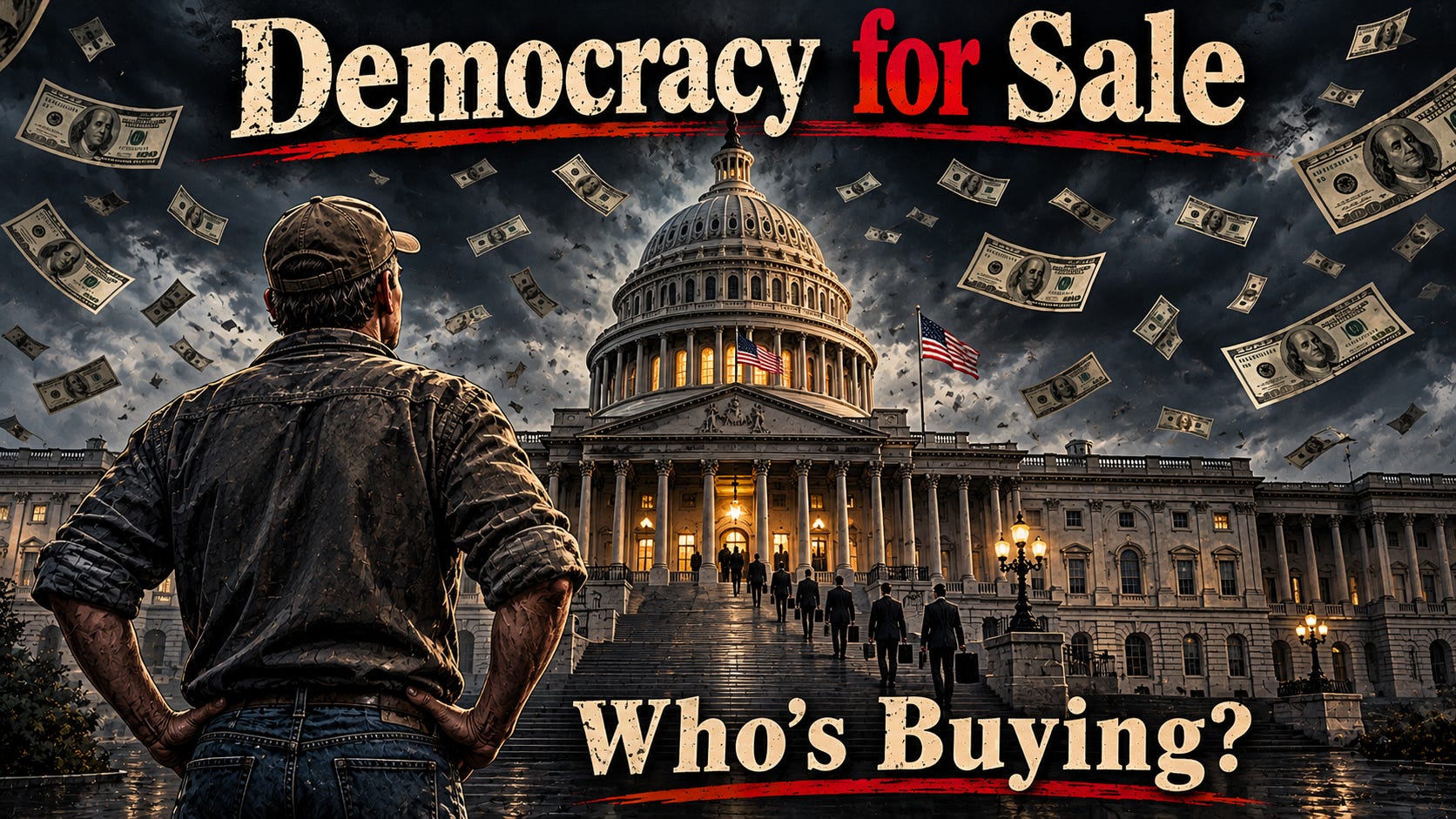
This is the core thesis of Democracy for Sale: when politicians rely on corporate cash to survive, they govern for the people signing the checks, not the citizens standing in line to vote. Citizens United blew the doors off the vault in 2010, and every election cycle since has set a grotesque new record.
Yet buried under all those billions is a genuinely hopeful headline: this year, the big money took some massive losses. Elon Musk’s $150 million couldn’t drag Ken Paxton across the finish line in Texas. AIPAC’s $31 million couldn’t stop Abdul El-Sayed, who campaigned explicitly on getting corrupt money out of politics. Voters can still beat the billionaire auction—provided we actually pay attention to who is doing the bidding. That is why we follow the money.
The Resistance Continues!
Like, Share, and Subscribe—because independent media is the only thing standing between us and the corporate oligarchy!
Follow my work:
Substack: democracy4sale.substack.com
Web: democracy4sale.com
Facebook: facebook.com/democracy4sale/
YouTube: youtube.com/democracy4sale/
Twitter/X & Bluesky
Rob Cain is the author of “Democracy for Sale: How Corporate Greed Is Corrupting Democracy and Endangering the Planet,” and writes “How to UnF*ck America” at democracy4sale.com.