By Rob C.
TL;DR: Calling Donald Trump a “Russian asset” isn’t a conspiracy theory—it’s a multi-decade financial and diplomatic paper trail. In a single week in September 2026, two massive receipts confirmed the pattern isn’t stopping; it’s accelerating. First, investigative reporting confirmed that a Putin-decorated Russian oligarch secretly bankrolled hundreds of thousands of dollars for Don Jr.’s May 2026 Bahamas wedding festivities. Days later, Trump publicly demanded that Ukraine stop striking Russian oil refineries—blaming Kyiv for rising US gas prices while ignoring his own administration’s conflict with Iran. But these September scandals didn’t happen in a vacuum. They follow a year of astounding backroom surrender: from the August 2025 Alaska summit where Trump secretly agreed to give away Ukrainian territory, to the leaked November 2025 “28-point plan” co-authored with Kremlin envoys. When personal family cash gifts from Moscow align perfectly with presidential policy favors for the Kremlin, we aren’t looking at coincidences anymore. We’re looking at a compromise in real time.
Good morning, America... while it lasts.
The Trump family has officially given up on hiding their four-decade financial romance with Vladimir Putin’s inner circle.
For years, mainstream pundits treated the phrase “Russian asset” as if it were some tinfoil-hat conspiracy theory. But when you look at the receipts—decades of Kremlin-linked money laundering into Trump real estate, followed by presidential policy decisions that consistently hand Moscow huge strategic wins at America’s expense—the pattern is undeniable.
And in September 2026, that exact pattern didn’t just repeat itself. It hit us twice in the exact same week.
The Decades-Long Financial Architecture
To understand what just happened, you have to remember the foundation. The Trump Organization didn’t accidentally stumble into Russian financial ties—they built their modern business model on them.
1984: Russian mob-linked figure David Bogatin buys five Trump Tower condos, which federal prosecutors later seize as a massive money-laundering operation.
2008: Donald Trump Jr. openly admits at a real estate conference: “In terms of high-end product retrieval, a disproportionate cross-section of our assets come from Russia.”
2008: Trump sells his Palm Beach mansion (Maison de L’Amitié) to Russian fertilizer oligarch Dmitry Rybolovlev for $95 million—a staggering $54 million above its assessed value.
2017: A Reuters investigation finds at least 63 Russian passport holders invested nearly $100 million into seven luxury Trump properties in Florida.
Layer on top of that Paul Manafort sharing internal campaign polling data with Russian intelligence operatives, Roger Stone coordinating with WikiLeaks, the 2016 Trump Tower meeting, and Trump standing on stage in Helsinki publicly taking Putin’s word over his own intelligence agencies.
All of that established the financial and political architecture. But what has unfolded over the past year takes the surrender to an entirely new level.
Capitulation: Alaska, Witkoff, and the 28-Point Surrender
Before looking at September’s scandals, you have to understand the diplomatic groundwork laid over the preceding twelve months.
On August 15, 2025, Trump met Putin directly in Alaska. Sources with direct knowledge of the summit revealed to The Guardian that Trump immediately informed European leaders he had agreed to Putin’s demand that Ukraine cede the entire Donbas region—both Donetsk and Luhansk provinces—even though Ukrainian forces still held key defensive fortress cities like Kramatorsk and Sloviansk. In exchange, Putin offered a temporary freeze on the frontline in Kherson and Zaporizhzhia.
Crucially, Trump then publicly pushed for a direct final “peace deal” rather than a preliminary ceasefire—the exact sequence European leaders warned against, because skipping a ceasefire locks in Russia’s military conquests as the permanent starting point for negotiations.
Then came November 2025, when a leaked 28-point draft plan exposed who was really writing U.S. foreign policy.
Drafted by Trump envoy Steve Witkoff alongside Secretary of State Marco Rubio and Jared Kushner, reporting revealed the plan was drafted after direct consultation with Kirill Dmitriev, a Russian presidential envoy. Leaked wiretaps further exposed phone calls between Witkoff and Yuri Ushakov, Putin’s top foreign policy aide. Parts of the U.S. “peace plan” were effectively written by the Kremlin itself.
The terms were a total Ukrainian surrender:
· Territorial Cleansing: Ukraine would completely withdraw from Donetsk and Luhansk, formally recognizing them and Crimea as Russian territory—despite Ukraine still defending roughly 14.5% of Donetsk at the time (per the Institute for the Study of War).
· Military Castration: Ukraine’s military would be capped at 600,000 personnel, its long-range striking capability stripped, and NATO membership constitutionally banned forever.
· Total Amnesty for Moscow: Russia would receive full global sanctions relief, re-entry into the G8, and escape military accountability—offering only a toothless promise not to invade other neighbors.
When European allies saw the plan, they pushed back sharply, convening emergency talks in Geneva in late November 2025 to offer a counter-proposal that protected Ukrainian sovereignty. Kremlin aide Yuri Ushakov rejected the European counter outright, calling it “completely unconstructive”—confirming that the original Trump-Witkoff draft was the exact wish list Moscow demanded.
By March 2026, President Zelenskyy confirmed the White House was still conditioning all post-war security guarantees on Ukraine surrendering the eastern Donbas. Trump didn’t even try to hide his framing, casually remarking in December 2025:
“Well, I think the land you’re talking about, some of that land has been taken. Some of that land is maybe up for grabs, but it may be taken over the next period of a number of months, and are you better off making a deal now...”
To Trump, sovereign territory isn’t something a democracy defends—it’s a real estate asset whose price is falling, so Ukraine had better sell before Moscow takes the rest.
Wedding Bells and Oligarchs
That brings us directly to September 2026, where the financial incentives behind this policy surrendered were laid bare.
Explosive reporting by ProPublica—corroborated by PBS, ABC, Axios, and Forbes—revealed that Don Jr.’s lavish May 2026 wedding weekend in the Bahamas was quietly bankrolled by Umar Kremlev.
Who is Umar Kremlev? He’s a Russian oligarch, president of the International Boxing Association, and a man personally awarded Russia’s Order of Friendship by Vladimir Putin himself in April 2026. Ukrainian sanctions documents explicitly flag him as part of Putin’s inner circle.
Kremlev didn’t just send a toaster. He rented private Bahamian islands at roughly $100,000 a night, dropped $70,000 on a private fireworks display, and had his personal team manage the entire event, running payments through a Dubai-based shell entity.
When the story broke, Don Jr.’s new wife, Bettina, didn’t even bother to deny it. She confirmed the payments directly, calling it “an extraordinarily generous wedding gift from a friend,” and tried to hide behind a legalistic technicality—claiming Kremlev only paid for the weekend party, not the “official” small family ceremony.
This isn’t an allegation. It is a confirmed six-figure cash gift from a Putin-decorated oligarch straight into the President’s family.
The Oily Truth: Protecting Putin’s War Chest
Days after the wedding scandal broke, Trump stood at his golf resort in Ireland on September 13, 2026, and dropped the policy favor.
Addressing reporters, Trump issued a direct demand to Kyiv:
“Zelenskyy has to do one thing. He has to stop knocking out diesel fuel in Russia... Don’t hit diesel fuel, because that’s hurting the world.”
Throughout 2026, Ukraine carried out a brilliant, highly effective drone strike campaign against Russian energy infrastructure—hitting all eleven of Russia’s largest refineries using long-range domestic drones. It forced Russia into a domestic diesel export ban and triggered widespread fuel rationing inside Russia. It was the single most effective military tactic destroying Putin’s ability to finance his war.
Predictably, Kremlin spokesman Dmitry Peskov immediately praised Trump’s statement, declaring: “Any call on the Kyiv regime to stop attacks on civilian economic infrastructure can only be welcomed.”
To make matters worse, Trump blamed Ukraine’s refinery strikes for US diesel prices crossing $6 a gallon on September 11. But independent analysts—and trackable naval data—showed the price spike was actually driven by the Trump administration’s military escalation with Iran, which nearly closed the Strait of Hormuz.
Trump literally took the podium in Ireland to sabotage the one military strategy squeezing Putin’s war chest, while using victim-blaming lies to cover up a price spike caused by his own war in the Middle East.
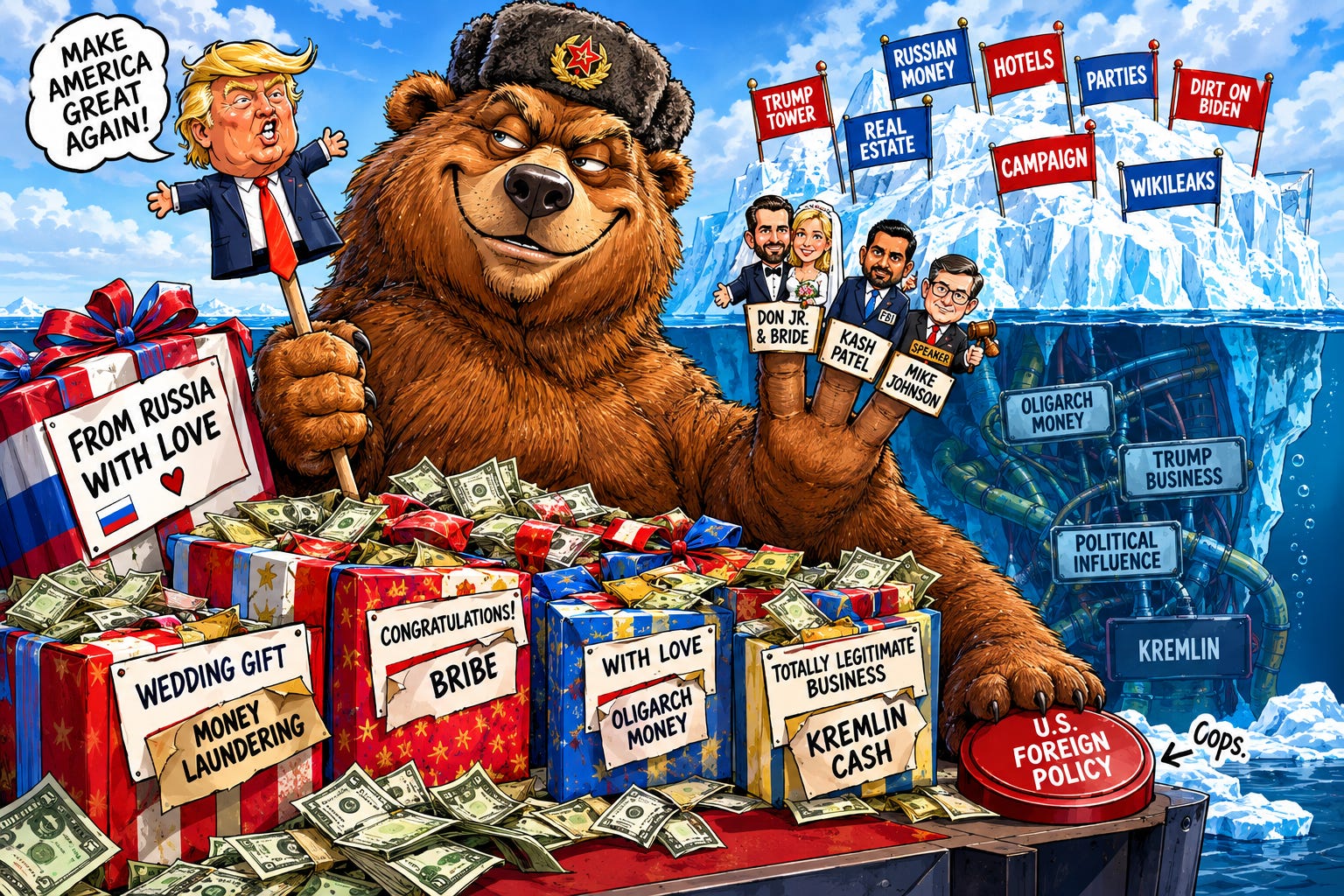
The Iceberg Effect
Individually, any of these stories—the Alaska territory giveaway, the Kremlin-authored 28-point plan, the oligarch-funded wedding, or the demand to stop hitting Russian refineries—would be a historic scandal. Together, they confirm the core thesis: personal financial entanglements running in parallel with presidential policy decisions that directly benefit the Kremlin.
This is the Iceberg Principle. What we can see above the surface—seized condos, Florida real estate cash dumps, Helsinki, Alaska, and a $100,000-a-night wedding gift—is just a tiny fraction of a massive, submerged financial relationship between the Trump family and the Russian state.
Don Jr. receives a six-figure party gift from a Putin insider in May. In September, President Trump publicly orders Ukraine to stop crippling Putin’s war machine. Neither fact relies on anonymous leaks; both are confirmed by the family’s own public statements and recorded remarks.
The question isn’t whether the Trump family is functioning as a Russian asset. The question is why anyone is surprised when the fox in charge of the henhouse keeps accepting expensive presents from bears.
Join the Resistance!
Like, Share, and Subscribe—because independent journalism is the one thing Moscow can’t buy with a wedding gift!
Follow my work:
Substack: democracy4sale.substack.com
Web: democracy4sale.com
Facebook: facebook.com/democracy4sale/
YouTube: youtube.com/democracy4sale/
Rob Cain is the author of “Democracy for Sale: How Corporate Greed Is Corrupting Democracy and Endangering the Planet,” and writes “Our Broken Systems” at democracy4sale.com.