By Rob C.
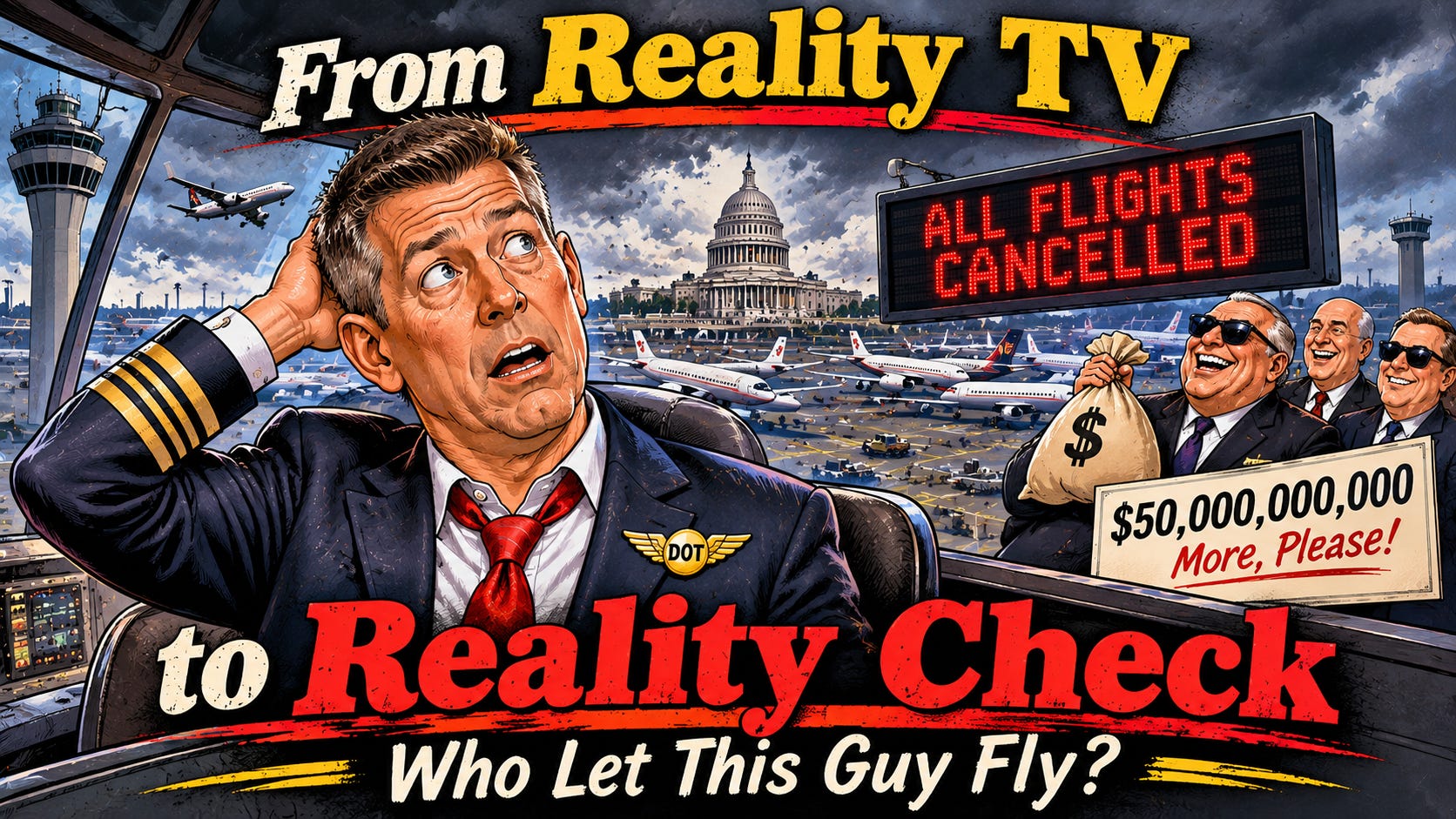
TL;DR: On Friday the 13th, the entire nation’s air travel ground to a halt for over four hours—just the second total nationwide grounding since 9/11. And who is sitting in the captain’s chair for this aviation faceplant? Sean Duffy, a former MTV reality TV contestant and Fox Business host who somehow landed the keys to the entire Department of Transportation. In the span of forty-eight hours, Duffy’s excuse for the meltdown mutated three times: first he blamed an overloaded router, then a telecom contractor he sheepishly admitted he can’t even fire, and finally—right on schedule—Joe Biden. Meanwhile, the actual air traffic controllers keeping planes from colliding in mid-air say they don’t buy a single syllable of his story. Add in the little coincidence that the AI startup whose new system went live nationwide just three days before the crash donated to Duffy’s son-in-law’s congressional campaign right before scoring a contract worth up to $875.9 million, and you’ve got a classic Washington special. Duffy’s bold solution to fix his agency’s catastrophic failure? Hand him another $50 billion, no questions asked.
Welcome back to the corporate-authoritarian plane wreck, folks.
Let’s get one thing out of the way: I genuinely believe in this country, and I believe the American people are far better than the circus we call our political system. That said, we do have a chronic, self-destructive habit of getting completely star-struck. From Ronald Reagan to Arnold Schwarzenegger, and straight on through to Donald Trump, if someone has spent enough time under studio lighting, voters will happily hand them the launch codes or the state budget.
And we owe our latest national travel nightmare to that exact celebrity obsession. Sean Duffy wasn’t exactly an A-list household name, but in the MAGA universe, having a decent TV Q-rating is the only credential you need to run multi-billion-dollar federal agencies that millions of people rely on to stay alive every single day.
In an administration where corruption and incompetence constantly compete for the spotlight, it’s hard to tell where one ends and the other begins. I’m not definitively declaring that foul play caused one of the rarest airspace shutdowns in American history. Whether the skies went dark because of a rogue “router” glitch or because a tech contractor donated to Duffy’s son-in-law right before miraculously winning an $875.9 million federal contract, I can’t prove beyond a shadow of a doubt. All I’m saying is, if it waddles like a duck and quacks like a duck...
From Road Rules to the Rules of the Road
Long before he was put in charge of keeping commercial airliners from bumping into each other, Sean Duffy was best known for living in a house with strangers on MTV’s The Real World: Boston in 1997, followed by a stint on Road Rules: All Stars.
To be completely fair, his résumé didn’t stop at reality television. He served as a county district attorney in Wisconsin and spent four terms in the U.S. House of Representatives before cashing in at the K Street lobbying firm BGR Group and landing a comfy desk job hosting on Fox Business. That’s where Donald Trump spotted him. What you won’t find anywhere on that CV—even with a magnifying glass—is a shred of experience in aviation safety, civil engineering, or managing a massive federal bureaucracy.
No matter. Trump handed him the Department of Transportation, putting him in charge of the FAA, the nation’s highways, rail networks, and pipelines. Then, apparently deciding that running Earth’s transit wasn’t keeping him busy enough, Trump made him the acting administrator of NASA from July to December 2025, letting him manage commercial airspace and outer space simultaneously. And whenever he wasn’t busy juggling rockets and runways, Duffy still carved out time to film a YouTube reality series documenting his cross-country family road trips with his wife, Fox News host Rachel Campos-Duffy, and their nine kids. New York Governor Kathy Hochul hit the nail on the head when she pointed out that he’s been far more focused on starring in his own family show than actually fixing his broken agency.
Friday the 13th
Just before 4:00 p.m. Eastern on Friday, November 13, a massive communications failure originating in the Chicago area rippled straight through the FAA’s network, forcing the agency to slam the brakes on every single departing flight in the United States. Roughly 4,000 planes were already airborne when the panic button got hit.
The outage tore through 17 of the FAA’s 22 en route air traffic control centers—the critical regional hubs that guide aircraft safely between takeoff and landing. At the FAA’s urgent request, transatlantic flights heading from Europe to the U.S. were suspended overnight.
The nationwide ground stop dragged on for 4 hours and 21 minutes, marking only the second complete aviation shutdown in the country since the September 11 attacks. At Atlanta’s Hartsfield-Jackson, the busiest airport on the planet, 15% of Friday’s flights were wiped off the board and nearly another 20% were delayed. Over 2,500 additional flights were canceled on Saturday, followed by more than 1,500 on Sunday. By the time the dust settled, an estimated 1.5 million travelers had their weekend plans completely torched.
The Excuse Generator
Watching the administration try to explain what happened was like watching a group project where nobody did the reading.
Friday night at the White House, Duffy offered a tidy, bite-sized explanation: “Our switches, our routers, actually got overloaded with data.” Standing right beside him, Homeland Security Secretary Markwayne Mullin immediately contradicted the script, suggesting the government’s own system upgrades were choking out legacy hardware, even as Duffy insisted the new gear was working like a charm. Mullin couldn’t even keep his own talking points straight, pivoting mid-briefing from “there is actually no cyber attack” to “there’s nothing completely certain right now.” The performance was so painfully bad that even conservative commentators trashed it online, with one prominent voice fuming that Duffy was “NOT explaining what the hell really happened.”
By Saturday, the administration had spun the wheel and landed on a brand-new villain: L3Harris, the defense and telecom contractor that owns and operates the FAA’s communications backbone. Duffy claimed a router at a remote facility in El Dorado, Arkansas, began firing off over 1,000 connection attempts every few seconds while L3Harris technicians were swapping out old copper lines for fiber-optic cables. Investigators, Duffy announced, were looking into “whether we had incompetence” from the contractor—before sheepishly admitting he “can’t cancel” L3Harris because the company literally owns the entire network. Pause and savor that for a second: the Secretary of Transportation openly confessed that the federal government is completely at the mercy of the private corporation running our skies.
By Sunday, the blame shifted one final time—straight into the rearview mirror. Asked on Meet the Press if he owed stranded Americans an apology, Duffy brushed it off: “I can’t apologize for what was passed off to us.” Over on CNN, he doubled down, declaring he would only take responsibility “for what was given to me by prior administrations.” Three days, three entirely different culprits, and somehow the one person who never makes the suspect list is the guy actually sitting in the Secretary’s chair.
The Pros Aren’t Buying It
While cable news pundits nodded along to Duffy’s shifting explanations, the actual professionals who keep aluminum tubes from crashing into each other at 500 miles per hour weren’t buying a word of it.
Washington Examiner reporter Anna Giaritelli interviewed 60 working air traffic controllers immediately after Duffy’s Friday press conference, and not a single one believed his story. Their skepticism comes down to basic operational common sense: major telecom swaps like moving from copper to fiber are strictly scheduled midweek, in the dead of night, when air traffic is at its absolute lowest. Nobody pulls the plug on critical network hardware at 4:00 p.m. on a Friday afternoon right as weekend travel peaks.
And the controllers have a second, much bigger grievance. According to reporting from Common Dreams, their union—the National Air Traffic Controllers Association (NATCA)—wasn’t even brought into the loop during the rollout of the FAA’s brand-new artificial intelligence traffic management system, which went live nationwide just days before the crash. Career aviation professionals with decades of life-or-death experience were locked out of the room while a former TV host and a venture-backed tech startup redesigned their airspace. That tells you everything you need to know about whose expertise this administration actually values.
A Pattern on His Watch
Friday’s meltdown wasn’t some freak, once-in-a-generation act of God. It was a sequel.
Spring 2025: Air traffic controllers managing Newark’s notoriously congested airspace suddenly lost both radar and radio contact with incoming planes—an incident so terrifying that five controllers had to take trauma leave afterward. Duffy’s big-brain solution was to cap flights while assuring the flying public that everything was totally fine.
September 2025: Another major communications outage snarled air traffic across New York and Philadelphia, blamed on a failed circuit and a severed backup fiber line.
The government’s own internal watchdog saw this train wreck coming from a mile away. In September, the Government Accountability Office (GAO) issued a blunt warning that Duffy’s rushed push to overhaul air traffic control was “buying delivery speed at the risk of cost uncertainty and potential disruptions.” And where was the single biggest cost overrun flagged by the GAO? Telecommunications—the exact network that just collapsed on Friday. Auditors also discovered the FAA was haphazardly juggling 11,389 separate project schedules that nobody had bothered to integrate into a single master plan.
To be fair to the facts, our aviation infrastructure genuinely is held together with duct tape and prayers: the GAO confirmed that more than three-quarters of the FAA’s air traffic control systems are either unsustainable or teetering on the edge. But “the system is old” stops being a valid excuse the moment independent auditors hand you a detailed warning explaining how your rushed, disorganized fix is going to break it.
And Duffy’s treatment of the workforce has been just as tone-deaf. During last year’s brutal 43-day government shutdown, air traffic controllers showed up every day and worked without a paycheck for over a month, forcing some to drive rideshares or take second jobs just to pay rent. Duffy’s grand gesture of gratitude? A $10,000 bonus strictly for “perfect attendance”—a requirement so narrow that, according to the union, only 311 controllers across the entire country qualified. Thousands of controllers who kept the skies safe without getting paid walked away with nothing.
If It Quacks Like a Duck
Now let’s get to the part of this story that really reeks.
On November 10—just three days before the nationwide meltdown—the FAA flipped the switch on its shiny new AI traffic management platform, known as SMART, across every regional control center in the country. The software was built by a Boston startup called Air Space Intelligence (ASI) under a federal contract worth up to $875.9 million. On Friday night, before a single investigator had even looked at the server logs, Duffy rushed to declare that the new AI system had nothing to do with the outage, bizarrely insisting that it “is not even plugged in.” That’s a fascinating thing to claim about a flagship system your own agency had literally just deployed nationwide seventy-two hours earlier.
SMART was already raising massive red flags on Capitol Hill. Back in October, 25 lawmakers formally urged the FAA to hit pause on the rollout until the agency could explain its safety testing, controller training, and human oversight protocols. The FAA plowed right ahead anyway—and is now actively negotiating to take a direct equity stake in ASI, a cozy arrangement that would simultaneously make the federal government the startup’s customer, regulator, and investor.
Here is where the duck really starts quacking. On March 31, 2026, ASI’s corporate political action committee cut a $2,500 campaign check to Michael Alfonso, a 26-year-old political novice with zero relevant experience who happened to be running for Duffy’s old congressional seat in Wisconsin. Oh, and one tiny biographical detail: Alfonso is married to Sean Duffy’s daughter. Exactly twelve weeks after that donation cleared, Duffy and FAA Administrator Bryan Bedford officially announced that ASI had landed the $875.9 million contract.
ASI was hardly the only company that suddenly discovered a deep passion for a 26-year-old first-time candidate in northern Wisconsin. Reporting from The Bulwark revealed that at least 25 registered lobbyists who actively lobby Duffy’s Department of Transportation also poured money into Alfonso’s campaign, alongside PACs tied to Delta Air Lines, Southwest, major automakers, and other corporations regulated directly by the DOT (Raw Story). Duffy himself transferred $1 million—half of his dormant congressional campaign war chest—into a super PAC boosting his son-in-law, while billionaire shipping magnate Richard Uihlein, whose business falls directly under DOT oversight, matched it with another $1 million. Alfonso told voters he answers only to God and the people of Wisconsin. He just won the election.
Let’s be crystal clear about where the evidence starts and stops. Twelve companies competed for the FAA contract; ASI beat out defense heavyweights like Palantir and Thales, and there is no smoking-gun document proving a $2,500 donation bought an $875 million contract. In Washington terms, $2,500 is couch-cushion change. Still, nobody in the administration has answered the most basic ethics question on the table: did Sean Duffy ever consult an ethics official or formally recuse himself from a massive contract decision involving a company actively bankrolling his own son-in-law? I’m not saying it’s a duck. I’m just saying it waddles, it quacks, and it’s doing laps in a taxpayer-funded reflecting pool.
The $50 Billion Shakedown
On November 12—the day before the FAA grounded the country—Sean Duffy was up on Capitol Hill asking Congress for an extra $30 billion. The day after his agency stranded 1.5 million Americans, Duffy and Markwayne Mullin marched back up to Congress and jacked their demand up to $50 billion—on top of the $12.5 billion lawmakers already approved last year. Duffy actually had the nerve to pitch the spending spree as a “Christmas present for the American people.”
Even his own party wasn’t buying the sales pitch. Republican Rep. Marjorie Taylor Greene blasted the joint briefing as “a shakedown for more money.” Democrats quickly pointed out that the Department of Transportation has only spent a tiny fraction of the modernization funds Congress already gave it, while Senator Tammy Duckworth noted that this administration always seems to find bottomless cash for political vanity projects while claiming the cupboard is bare for basic air traffic safety. Duffy’s reassuring response? The existing money is “all accounted for,” and he’ll get around to explaining the rest later.
So let’s review the offer sitting on the table for American taxpayers: the guy whose agency just shut down national airspace, who blew past federal watchdog warnings, who couldn’t keep his story straight for forty-eight hours about what actually broke, and whose son-in-law’s congressional campaign was bankrolled by corporations regulated by his department wants you to hand him four times more money, no strings attached.
A Tragic Comedy
As hundreds of thousands of exhausted travelers slept on terminal floors, thousands of flights vanished from departure boards, and the economic damage ticked into the billions, it’s worth taking a long, hard look in the mirror. Are we going to keep letting ourselves get dazzled by reality TV casting and cable news charisma, or are we finally going to demand that the people entrusted with keeping airplanes in the sky actually know how to do the job?
I’ve written plenty about the myth of America’s supposed “meritocracy,” but watching a former Road Rules cast member ask for a $50 billion blank check after grounding the entire country has officially turned our infrastructure policy into a tragic comedy.
The Resistance Continues!
Like, Share, and Subscribe—because independent media is the only thing standing between us and the corporate oligarchy!
Follow my work:
Substack: democracy4sale.substack.com
Web: democracy4sale.com
Facebook: facebook.com/democracy4sale/
YouTube: youtube.com/democracy4sale/
Twitter/X & Bluesky
Rob Cain is the author of “Democracy for Sale: How Corporate Greed Is Corrupting Democracy and Endangering the Planet,” and writes “How to UnFck America” at democracy4sale.com.*