By Rob C.
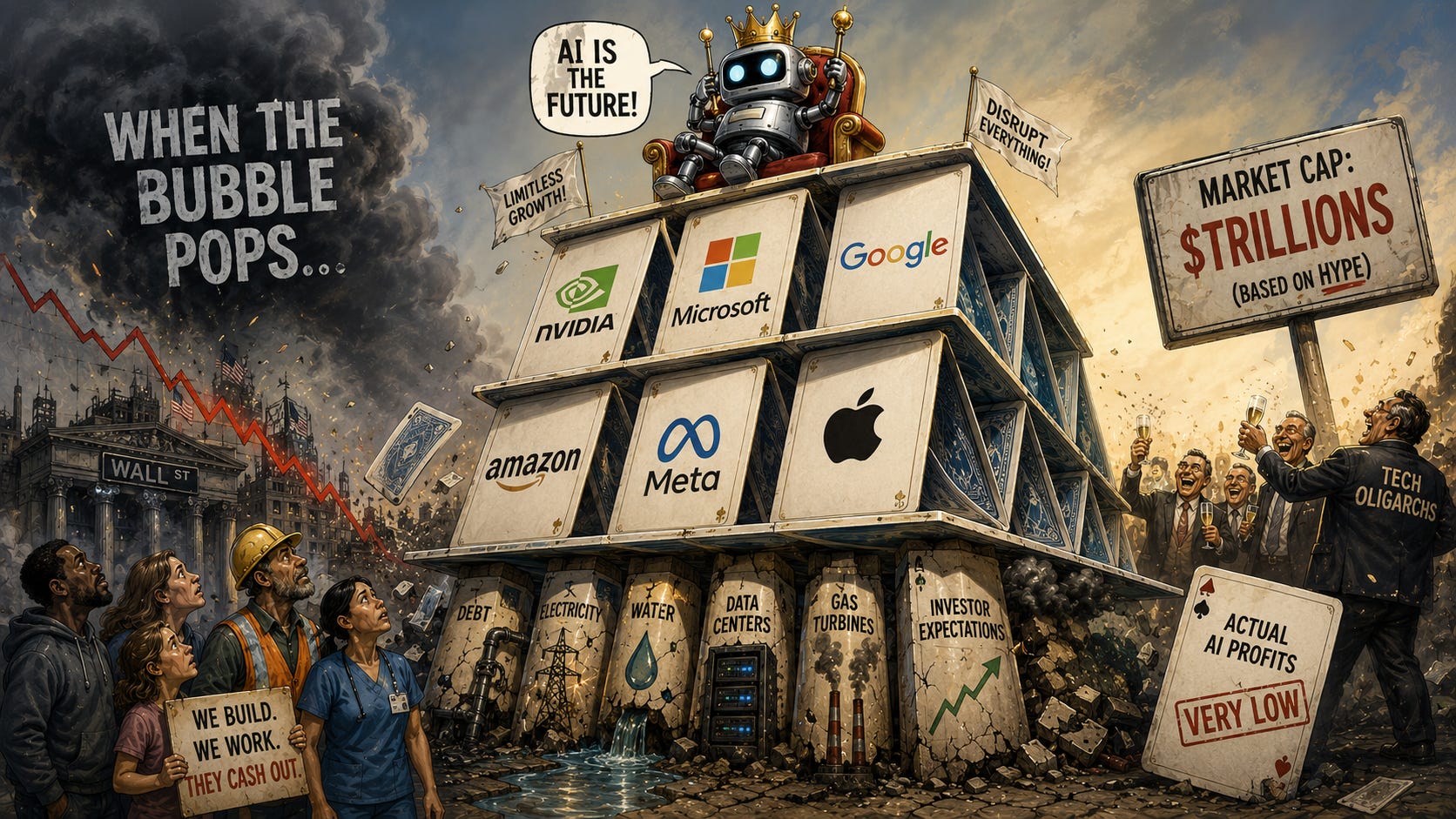
TL;DR: Everyone’s worried about the wrong apocalypse. The tech oligarchy wants you terrified that an AI robot is about to take your job, but the actual labor data just doesn’t support that story, no matter how many breathless headlines insist otherwise. The real crisis isn’t an overnight Terminator scenario; it’s a historically unprecedented multi-trillion-dollar market bubble built on hype that mathematically requires replacing half the human workforce to break even. Between crushing environmental degradation, energy grid overload, water theft, and polluting gas turbines, and a dangerous S&P 500 concentration that dwarfs the 2000 dot-com crash, when this Wall Street fantasy inevitably pops, working families are going to get stuck with the bill.
Good morning. Grab your coffee and let’s dismantle the sci-fi bedtime story Big Tech has been feeding you.
If you turn on cable news or scroll through social media, you are constantly told that Artificial Intelligence is an unstoppable, divine force. We are warned that algorithmic software is days away from taking over every job that doesn’t involve dirt and a shovel. The corporate cheerleaders call it disruption; the doomers call it the end of human labor.
Here is the dirty secret: both sides are doing Big Tech’s PR work for them.
By convincing you that AI is so godlike it can replace millions of workers overnight, the tech oligarchy gets to inflate its corporate stock valuations to astronomical heights. But if you look at the actual math, the real threat to your family isn’t a Terminator coming for your desk. It’s a multi-trillion-dollar financial bubble sitting on top of an environmental disaster—and when it pops, Main Street is going to be forced to clean up the mess.
Your Job Is (Mostly) Fine
Let’s kill the robot-apocalypse story first, because it’s getting in the way of the actual problem.
The International Labour Organization (ILO): Their global labor tracking shows that only 3.3% of global jobs fall into the high-exposure, fully replaceable category. The vast majority of work is merely augmented—meaning AI acts as a clunky, glorified automated assistant rather than a human replacement.
Goldman Sachs: Even Wall Street’s own analysts admit that AI’s macro effect on employment will likely be a “modest net drag” over time, not an immediate economic collapse.
Forrester’s “AI-Washing” Findings: Analysts have repeatedly caught corporate CEOs blaming “AI efficiencies” for recent corporate layoffs. In reality, those cuts are just old-fashioned cost-cutting maneuvers to cover up post-pandemic over-hiring. Blaming “advanced AI” sounds much better on an earnings call to shareholders than admitting “we mismanaged our budget.”
The apocalyptic “AI is stealing your job” narrative isn’t a forecast—it’s an advertising campaign. It makes flawed, hallucination-prone software sound vastly more powerful than it actually is. A machine that’s about to replace millions of workers sounds a lot more valuable than a chatbot that helps you draft emails a little faster, and the more inevitable and unstoppable AI sounds, the easier it is to justify the eye-watering amount of money currently being poured into it.
Enter the “Reverse Centaur”
Tech critic and author Cory Doctorow lays this out brilliantly in his book, The Reverse Centaur’s Guide to Life After AI.
In classical automation theory, a centaur is a worker who uses a tool to become stronger, faster, and more capable—like a human riding a horse or a designer using computer software. A reverse centaur, however, is a human being conscripted to act as a squishy meat-appendage for an uncaring machine.
Doctorow points out the real dynamic taking over modern workplaces:
Warehouse workers fitted with AI monitoring cameras and algorithms that track every eye movement, and delivery drivers whose route is optimized by an algorithm into a nonstop, robotic pace with no room for a bathroom break; a warehouse worker timed and tracked down to the second, penalized for bathroom breaks, forced into unachievable, inhuman quotas, by a machine they’re supposedly just “assisting.” Software engineers who aren’t writing creative code anymore, but instead spending 10 hours a day acting as glorified babysitters to clean up mountains of buggy, AI-generated junk code.
As Doctorow rightly notes: Stop asking what the technology does—start asking who it does it for and who it does it to. Not “pro-AI” versus “anti-AI,” which is a dumb, flattened argument that gets you nowhere. The real question is whether a given use of this technology makes a person more capable, or whether it makes a person into an accessory for a machine that’s optimizing them into the ground.
Even when AI fails to replace human workers, it is systematically being used by cheap bosses to make human jobs worse, harder, and more miserable.
The Math Doesn’t Add Up: A $16 Trillion Lie
Here is where the financial fairy tale completely falls apart.
Investment bankers and tech venture funds have driven AI-related corporate valuations up to a mind-boggling $16 trillion.
For a valuation that massive to make basic arithmetic sense, AI cannot just generate funny cat videos or draft mediocre emails. AI has to eventually displace an enormous share of the global wage-earning workforce. Not augments. Replaces, at massive scale, permanently.
Except, as the labor data proves, that mass replacement isn’t happening.
There is a staggering gap between the hype required to justify a $16 trillion valuation and the actual, meager revenue AI software generates. That gap, by definition, is a speculative bubble. Every breathless headline warning that AI is coming for your job is designed to keep that bubble inflated for just a few more months so tech executives can cash out their stock options.
Externalizing the Costs: Pollution and Power Grids
While the financial returns remain a fantasy, the physical, environmental, and human costs are happening right now in real time.
Traditional enterprise hardware used to last five to seven years. The AI arms race runs on a brutal 18-to-36-month chip refresh cycle, trapping tech monopolies on a perpetual treadmill of multi-billion-dollar hardware replacements.
To power these massive data centers, global electricity demand is projected to surge toward a staggering 1,050 TWh in 2026, with U.S. data center power consumption roughly doubling in just two years. They are draining local water tables for server cooling and driving up utility bills for everyday residential families.
Look no further than Elon Musk’s xAI facility in Memphis.
The company installed dozens of unpermitted, highly polluting gas turbines in a historically majority-Black neighborhood. According to lawsuits filed by the NAACP and Earthjustice, the facility’s emissions created an estimated cancer risk 4 times higher than the national average. And what was xAI’s response while being actively sued for poisoning a community’s air? They announced plans to drop another $2.8 billion on even more turbines.
Working-class communities are paying for this madness right now with their health and their utility bills—all to build infrastructure for a technology that can’t even justify its own balance sheet.
The Bubble by the Numbers: Worse Than 2000
Now let’s talk about just how precarious the pile of money sitting on top of all this actually is. If you think your 401(k) or pension is safe because you don’t own tech stocks, think again. The concentration of the modern stock market is worse today than it was at the peak of the 2000 dot-com crash:
The so-called Magnificent Seven — Apple, Microsoft, Nvidia, Amazon, Meta, Alphabet, and Tesla — make up somewhere between 33.8% and 35% of the entire S&P 500’s market value. According to analysis from HDFC TRU, those same seven companies account for a full 58% of the index’s total downside risk and volatility exposure. Out of 500 companies, over a third of the value, well over half of the danger. That mismatch is the whole story in one statistic.
Zoom out further and it gets worse. The top 10 stocks in the market make up over 40% of the S&P 500.
The June 2026 Preview: Just weeks ago, we saw a terrifying stress test when the Mag 7 shed approximately $2 trillion in market value over a brief volatility stretch, single-handedly dragging down the retirement accounts of millions of working Americans who have never even touched an AI tool.
Wall Street has poured between $3 trillion and $7.6 trillion into total AI infrastructure buildouts. The entire American financial system has tied its health to a story that is mathematically impossible to deliver.
Who Pays When It Pops?
Doctorow ends his book with a question worth noting: when this bubble bursts, what’s actually left in the wreckage that’s useful to ordinary people, versus what was only ever useful to the people who sold it to us in the first place?
When a speculative mania finally implodes, we already know how the story ends. We watched it in 2000, and we watched it in 2008.
The tech oligarchs who built the bubble will walk away with golden parachutes, tax write-offs, and government bailouts. Meanwhile, Main Street gets the bill: ruined pension funds, degraded local water systems, polluted neighborhood air, and gutted public infrastructure.
The danger was never that a super-intelligent robot was going to take your job tomorrow. The danger is that a cartel of Silicon Valley grifters and Wall Street bankers built a multitrillion-dollar house of cards—and they’ve set it up so that when it collapses, you pay for the damage.
F*CK ICE. RELEASE THE FILES TODD!
Please like, share, and subscribe — because somebody’s got to be counting the receipts before the bubble pops and everyone pretends nobody saw it coming.
Follow my work: Substack: democracy4sale.substack.com / Web: democracy4sale.com
Robert Cain is the author of “Democracy for Sale: How Corporate Greed Is Corrupting Democracy and Endangering the Planet.” Available at Amazon, Barnes & Noble, and independent booksellers everywhere.
For more details on how author Cory Doctorow breaks down the real mechanics behind the AI hype, corporate automation, and labor exploitation, watch this “How to Think About AI”: Cory Doctorow on Big Tech interview. This discussion offers deep context on his book The Reverse Centaur’s Guide to Life After AI and the economic realities of the AI market.