By Rob C.
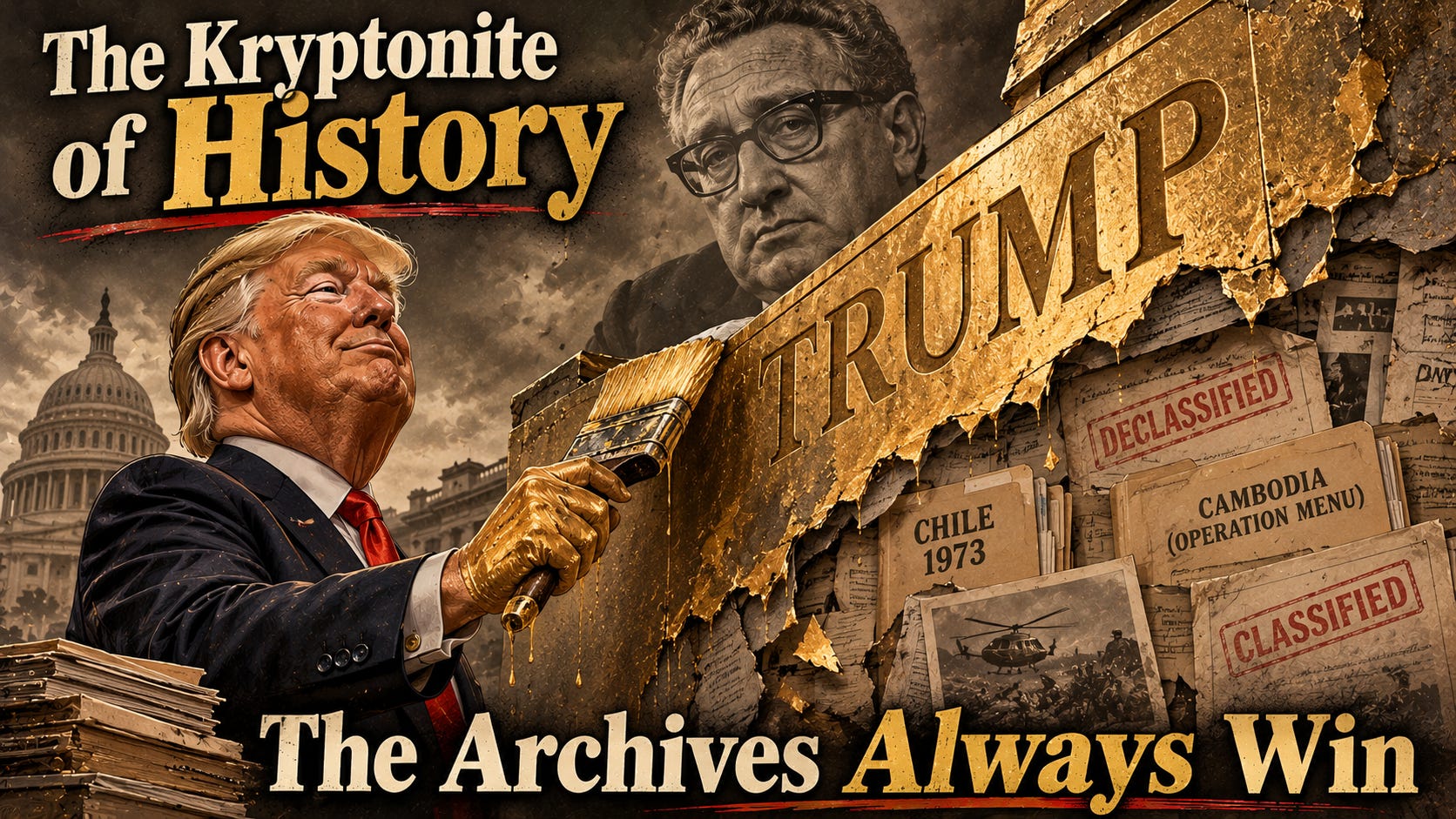
TL;DR: Donald Trump is desperately trying to outrun his own legacy by slapping his name on buildings, gluing fake gold onto the Oval Office walls, and bragging about ending imaginary wars. Newsflash: history doesn’t care about your interior decorating. Just ask Henry Kissinger, the original master of turning blood-soaked foreign policy into five-star media acclaim. For decades, Kissinger charmed news anchors, bullied critics, and buried his role in the slaughter of hundreds of thousands of people in Chile and Cambodia—until declassified government archives blew his pristine reputation to smithereens. You can buy off the pundits and intimidate the press while you’re in power, but you can’t bribe the archives.
Anyone with two functioning eyes can see that Donald Trump’s frantic quest to slap his name on every monument in Washington—from the Kennedy Center to a tacky new ballroom—is a desperate attempt to rewrite history before it even happens. No matter how much gold leaf he glues onto the walls of the Oval Office, he will never scrub off the stain he has left on this country and its Constitution.
Trump loves claiming credit for things that never happened—like stopping six, seven, or was it eight wars this week?—or pretending he’s done more for Black Americans than Abraham Lincoln. He is the ultimate political parade-jumper: he spots a crowd marching down the street, sprints to the front, and acts like he organized the whole thing.
Unfortunately for authoritarian wannabes, history has an annoying habit of keeping receipts. Before Stephen Miller and the MAGA spin machine, there was the undisputed heavyweight champion of diplomatic bloodletting and reputation laundering: Henry Kissinger. For anyone unfamiliar with how the game is played at the highest levels, here is a quick, unvarnished history lesson.
Before Stephen Miller, There Was Henry Kissinger
Henry Kissinger held the levers of American foreign policy for roughly eight years as Nixon’s National Security Adviser and Secretary of State. Yes, he opened diplomatic doors to China and negotiated détente with the Soviet Union. Those achievements are real.
What he spent the next fifty years trying to bury, however, is a record written in human blood—and two countries tell the story better than anywhere else:
· Chile (1970–1976): When Chileans democratically elected socialist Salvador Allende in 1970, Kissinger sneered at a secret committee meeting: “I don’t see why we need to stand by and watch a country go communist due to the irresponsibility of its own people.” Despite his own advisers telling him Allende posed zero mortal threat to the U.S., Kissinger oversaw a covert CIA coup plot (”Track II”) that led directly to the assassination of Chile’s top military commander, General René Schneider, who refused to overthrow his own government. When the initial coup fizzled, Kissinger whined to Nixon that the Chilean military was “a pretty incompetent bunch,” showing zero remorse for Schneider’s murder. After three years of U.S.-engineered economic sabotage, General Augusto Pinochet seized power in 1973, ushering in a dictatorship that murdered or disappeared roughly 3,200 people. In 1976, Kissinger privately told Pinochet, “You did a great service to the West in overthrowing Allende,” assuring the dictator he could ignore Kissinger’s upcoming public speech on human rights. Three months later, Pinochet’s agents assassinated Allende’s former foreign minister, Orlando Letelier, with a car bomb right in the middle of Washington, D.C.—a man Pinochet had complained about to Kissinger twice during their meeting.
· Cambodia (1969–1973): Officially neutral, Cambodia became a secret free-fire zone one month after Nixon took office. Kissinger and his aide Alexander Haig designed Operation Menu, a covert carpet-bombing campaign hidden from the American public, Congress, and even senior Pentagon brass using fake records and cute culinary code names like Breakfast, Lunch, Dinner, and Dessert. Military leaders knew civilians lived in the target zones and expected massive casualties. When The New York Times exposed the secret bombings in 1969, Kissinger’s White House responded by illegally wiretapping his own staff and journalists to hunt down leakers. By 1973, U.S. planes had dropped over 500,000 tons of bombs on Cambodia. Following a furious 1970 call from Nixon, Kissinger barked orders to Haig for “a massive bombing campaign... Anything that flies on anything that moves”—an order the notetaker recorded Haig literally laughing at. Experts estimate the bombing killed up to 150,000 civilians (six times the civilian death toll of post-9/11 U.S. airstrikes), shattered Cambodian society, and paved the bloody road for the Khmer Rouge genocide. Until the day he died, Kissinger claimed he never bombed Cambodia—only the North Vietnamese inside it. Military logs and survivors say otherwise.
The Nobel War Prize
In 1973, in a display of dark comedy that still hasn’t been topped, the Nobel Committee awarded Kissinger the Peace Prize alongside North Vietnamese negotiator Le Duc Tho for the collapsing Vietnam ceasefire. Tho had the basic decency to refuse it—remaining the only person in history to turn down the Peace Prize—while two Nobel Committee members resigned in disgust. Kissinger skipped the ceremony entirely out of fear of anti-war protesters, and The New York Times accurately dubbed it the “Nobel War Prize.”
Master of Misinformation
Kissinger’s true superpower wasn’t diplomacy; it was narrative control. In office, that meant fake logs and illegal wiretaps. Out of office, it meant five decades of relentless PR manipulation.
As historian Barbara Keys documents in Super K, Kissinger ran a ruthless carrot-and-stick operation on the American media. The carrot was exclusive access, charm, and dinner parties at his Connecticut estate. His closest allies sat at the pinnacle of corporate journalism: ABC’s Ted Koppel practically handed him the moderator’s chair on Nightline; Barbara Walters kept him at her side during election coverage; Washington Post owner Katharine Graham gushed over him in her memoir; and Newsweek literally put him on its cover dressed as a cartoon superhero (”Super K”).
The stick came out whenever anyone dared tell the truth:
· When authors William Shawcross and Seymour Hersh published devastating exposés on Cambodia, Chile, and the wiretaps, Kissinger fired off massive letters framing criticism of himself as a threat to “national security” and teamed up with Koppel to trash Hersh on national television.
· When historian Kenneth Maxwell wrote a critical review regarding Chile in Foreign Affairs, Kissinger leaned on Council on Foreign Relations leadership until Maxwell was forced out.
· When President George W. Bush tapped Kissinger to chair the 9/11 Commission in 2002, Kissinger abruptly quit within weeks rather than disclose the private client list of his consulting firm, Kissinger Associates. Given the choice between public accountability and secrecy, secrecy won every time.
Kissinger wasn’t alone in manufacturing a spotless legacy. In 1997, anti-tax crusader Grover Norquist launched the Ronald Reagan Legacy Project to name something after Reagan in every single one of America’s 3,000-plus counties, openly admitting: “If you want to contend for the future, you have to contend for the public understanding of the past.” It worked like magic. By the time Reagan died in 2004, cable news anchors were crowning him the most popular president in modern history—conveniently forgetting that his average approval rating sat in the mid-50s (lower than Bill Clinton’s), plunged to 35% during the 1983 recession, and tanked below 50% again during Iran-Contra. Movement conservatives needed a saint, so PR built them one.
The Kryptonite of History
Here is the fatal flaw in every strongman’s PR strategy: the archives always win in the end.
Kissinger’s carefully manicured myth began disintegrating while he was still alive. Following Pinochet’s 1998 arrest in London, thousands of declassified U.S. cables laid bare Kissinger’s fingerprints all over the Chilean coup. The National Security Archive pried loose over 30,000 pages of phone transcripts that Kissinger had secretly recorded himself. On his 100th birthday in 2023, The Intercept published newly uncovered military records proving he was responsible for far more civilian carnage in Cambodia than previously documented. When he finally died that November, half the obituaries called him a statesman, and the other half called him a war criminal. You can wine and dine network anchors and intimidate magazine editors, but you cannot buy off declassified documents.
Which brings us right back to Donald Trump. Slapping his name on cultural centers, gilding the Oval Office like a cheap casino, building vanity ballrooms, and inventing imaginary peace treaties—it’s the exact same Kissinger playbook dipped in spray-on gold. Control the narrative while you hold the megaphone, and pray the myth outlives you.
History guarantees it won’t.
The Resistance Continues!
Like, Share, and Subscribe—because independent media is the only thing standing between us and the corporate oligarchy!
Follow my work:
Substack: democracy4sale.substack.com
Web: democracy4sale.com
Facebook: facebook.com/democracy4sale/
YouTube: youtube.com/democracy4sale/
Twitter/X & Bluesky
Rob Cain is the author of “Democracy for Sale: How Corporate Greed Is Corrupting Democracy and Endangering the Planet,” and writes “How to UnFck America” at democracy4sale.com.*